
Quick Answer: Lightning rarely damages electronics by hitting a house. A strike some distance away induces a brief, very high voltage onto power, coaxial, and buried lines. That transient travels indoors and destroys equipment sitting between two of those paths.
Most lightning damage to home electronics comes from strikes that never hit the house. The energy arrives on the wires. A discharge some distance away imposes a rapid voltage rise on conductors that already run into your walls, and that rise occurs inside the building before anything outdoors shows a mark. That is why a television, a router, or the control board in an appliance can be dead the morning after a storm while the roof, the meter, and the yard look exactly as they did the day before.
How a Nearby Strike Puts a Transient on a Line
A transient is a voltage that rises well above the normal supply voltage and then collapses again within microseconds. Your outlets deliver a smooth, repeating waveform at a steady level, and a transient is a spike riding on top of it, gone before a meter's display could react and easily many times what the wiring and equipment were built around.
Induction does most of the work. A lightning channel carries an enormous current that appears and vanishes in a fraction of a millisecond, and a current changing that fast throws a magnetic field out around it. Any conductor sitting within that field has a voltage induced along its length, even without direct contact. An overhead service drop, a buried cable, a coaxial line on the pole, a low-voltage run across a yard: each acts as a pickup for a strike it never met.
Conduction accounts for the rest. When lightning strikes a utility distribution line well away from your street, the energy travels along the conductors as a wave in both directions, passes through the utility's pole-mounted equipment, and reaches the service feeding a house. Distance weakens it. Distance does not stop it.
Both mechanisms end the same way at your panel: a brief voltage the equipment downstream was never designed to see.
The Paths That Bring Surge Energy Indoors
Several separate systems terminate inside a house, and each one is a possible entrance.
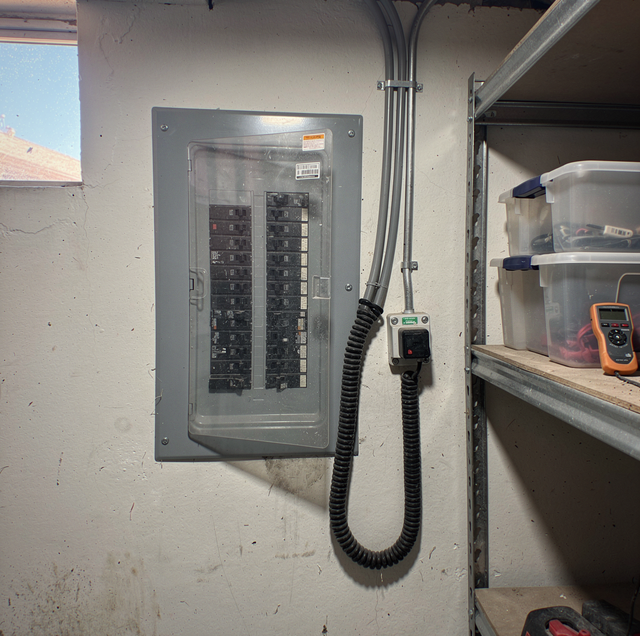
The service conductors: The main power feed is the largest path, and the one most homeowners picture first. Every branch circuit sits downstream of it.
The coaxial or fiber entrance: Coax is copper, and a television or internet drop running along the same poles as the power line picks up induced energy the same way. Fiber is glass and carries no current itself, but the equipment it feeds is plugged into an outlet, and most homes on fiber still have a copper line entering for some other service.
A buried line to a detached structure: A feeder to a garage, shop, well house, or pool equipment pad is a long conductor with sufficient length to collect induced voltage, and it connects back to the house electrical system at the other end. Energy that gets onto it out at the shop has a direct route back to the panel.
The earth under the property: When strike current enters soil, it spreads outward, and the voltage at any point depends on how far that point sits from the entry. Two grounded reference points on one property, some distance apart, can sit at different potentials for a few microseconds. Equipment touching both, such as a camera at the shop wired back to a recorder in the house, sees that difference across its inputs.
Energy needs a way in and a way out, which is why the number of entrances matters so much.
Why One Device Fails and the Next One Survives
The answer comes down to what the device's own power supply tolerates and which paths the energy used to get in and back out.
Supply tolerance. Nearly everything with a screen or a circuit board runs on a switch-mode power supply, which converts incoming line voltage down for the electronics behind it. Its input stage is built with headroom above the normal service voltage; a spike hundreds of times higher lies outside that headroom. Once the transient exceeds what those components can withstand, a semiconductor junction breaks down and the supply is lost. A table lamp with a filament, a resistive heating element, or a simple motor has nothing that delicate inside, so the same spike passes through and does nothing.
The two-path question: A device plugged into one outlet with nothing else attached is a poorer route for surge energy, because there is no convenient exit, though the equipment ground in a three-wire cord still offers one. A device with a power cord and a second cable running somewhere else is a bridge between two systems. Voltage arrives on one, leaves on the other, and crosses the circuit board along the way. That is the difference between the television that died and the lamp on the same outlet that survived, and between the desktop wired to the router and the laptop on Wi-Fi beside it.
If you smell burning, see scorching at an outlet, find a breaker that will not reset, or spot damage at the service entrance, stop using that circuit and call a licensed electrician. Do not open enclosures or handle the equipment.
Immediate Failure and Cumulative Damage
A surge that kills outright leaves an obvious result. The device will not power up, a fuse inside has opened, or a board carries a scorch mark. You connect the loss to the storm because the timing is unmistakable.
The quieter outcome is more common and much harder to attribute. A transient that stays below the level needed to destroy a component still stresses it. Electrolytic capacitors in a power supply lose capacity gradually under repeated overvoltage. Semiconductor junctions collect microscopic damage that never quite adds up to an open circuit. Nothing changes on the outside. What changes is margin: the supply that used to hold steady through a warm afternoon now sags, the control board that used to start every time now needs two tries, and the display flickers before it goes dark for good.
This is why an appliance that "died months later" can still be a surge casualty. The failure arrives looking exactly like ordinary wear, and by then nobody links it to the night the storm came through. It is also why the case for protection gets made in advance. After the fact, an electrician can confirm a device is dead and check whether wiring was damaged, but the sequence that used up its margin is gone.
The Limits of Protection at the Service Entrance
A protective device installed at the service equipment pulls down the peak of the voltage arriving on the incoming power conductors. What matters for your electronics is where that coverage runs out.
It covers one path. The device taps across the incoming conductors rather than carrying the load current, and it diverts the surge to ground. Because it is connected in parallel, its own lead length dominates its performance: every inch of conductor between the device and the bus adds let-through voltage, which makes short, straight, untwisted leads the biggest variable in how well an installation works. The coaxial entrance on the other side of the house never touches it. A feeder running out to a detached building carries its own exposure. A difference in earth potential between two points on a property is not something a device on the power feed can see at all.
It reduces rather than removes. What continues past it travels down the branch circuits at a lower but still meaningful voltage, and delicate electronics can exceed their own limits even after that reduction.
Distance works against it as well. Every foot of branch-circuit wiring between the service equipment and an outlet adds inductance, and a fast transient develops voltage across it, so equipment at the end of a long run sees more than equipment near the panel.
A direct strike to the structure is a different event entirely. A discharge that terminates on the house puts current through everything at once, in quantities no protective component is built to survive. No product installed in a home is a guarantee against it.
Where Protection Has to Sit to Work
Protection has to sit at the boundary the equipment actually has. If a device has one wire going into it, one protected point covers it. If it has two, both lines have to be handled at the same place and referenced to the same ground, or the protection has a hole in it that the energy will find.
Count the lines going into each device: A television with a power cord and a coaxial lead has two. A game console with power and an Ethernet cable has two. A modem or router has power plus the incoming service line. A camera recorder has power plus every camera run coming back to it.
Handle both lines at one point: This is why point-of-use protectors with coaxial or data pass-through exist. The coax and the power cord land at the same unit, both get clamped to the same reference at the same instant, and neither can serve as the open door while the other is closed. A protector covering the outlet alone leaves the second line free to bring energy in and carry it back out, straight across the board.
Keep it close and keep it simple: Point-of-use protection does its best work right at the equipment, on short leads. Long cords between the protector and the device give residual voltage room to develop again. Chaining one strip into another adds outlets and adds nothing to the protection.
Treat the layers as a set: The service-entrance device takes the bulk of what arrives on the power feed, and the point-of-use device handles the residue that gets past it along with the paths it never saw. Neither one is a complete answer on its own, and together they reduce risk without eliminating it.
Which lines a particular house actually has is worth an electrician's eyes. Requirements also vary by jurisdiction, so a licensed electrician confirms what applies where you live.
Walk the house once and list every device with more than one cable going into it. Those are where surge energy has both an entrance and an exit, and they get point-of-use protection first, though single-cord electronics still benefit.
Frequently Asked Questions
Yes. The clamping components inside a point-of-use protector, usually metal-oxide varistors, take a little damage each time they divert energy, and they eventually stop protecting while the outlets continue passing power normally. Many units carry a small protection-status light that goes dark when that happens, which is easy to miss because the strip still works as a strip. A unit with no indicator is an unknown after any hard storm.
No. A plain relocatable power tap splits one outlet into several and contains no clamping components at all, and the two look nearly identical on a shelf. The difference shows on the packaging and the listing label: a surge protector carries a surge energy rating and names surge suppression, while a plain tap lists only its outlet count.
It does, within limits. Unplugging only helps if it happens before the weather arrives, and you should not be handling cords with a storm overhead. It also only helps if every line comes out. A television still on its coaxial lead, a computer still on an Ethernet cable, or a thermostat still wired to its low-voltage run keeps a path open even with the plug in your hand.
Yes, and small ones do constantly. Every time a large motor load switches off, an air conditioning compressor, a well pump, or a refrigerator, the collapsing magnetic field in its windings pushes a brief voltage spike back onto the circuit. These internal events carry far less energy than a lightning-driven transient and occur far more often, which is why point-of-use protection is effective in clear weather.
That pattern usually comes from protective equipment on the utility's distribution line. When a limb touches a conductor or lightning causes a momentary fault, the equipment opens the line and automatically closes it again a moment later, repeating a set number of attempts to see whether the fault has cleared. Each open and close is a switching event your house feels, and it is normal utility operation.
It cannot, because it is built for a different timescale. Clamping components respond to transients lasting microseconds and shed that energy quickly. A sustained overvoltage, such as the kind an open neutral on the service creates, maintains an abnormal voltage on the circuits for minutes or longer, overwhelming a clamping device and damaging equipment throughout the house. That condition calls for the utility and a licensed electrician.
Get the surge paths into your home mapped — a licensed electrician can identify every conductor entering the house and where layered protection belongs. The Plug Electrical Services serves Corpus Christi, Odem, and Portland. Call (361) 282-3058.
