
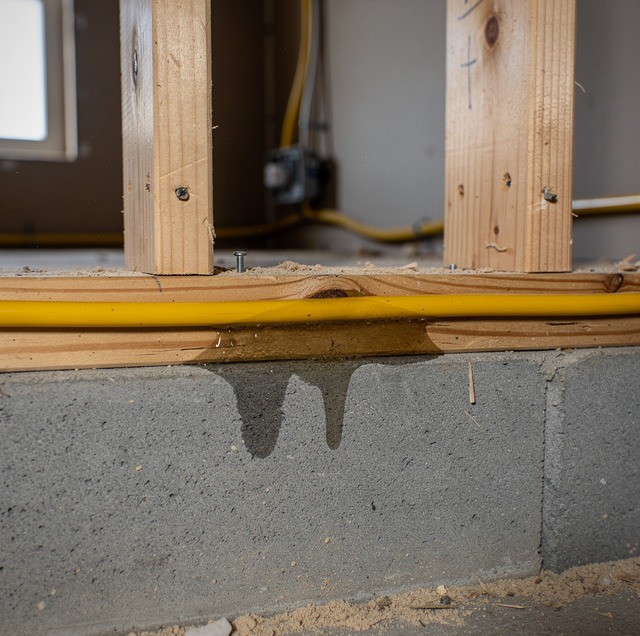
The water is gone from your rooms, your floors are drying, and you are left with a question you cannot answer by looking: did the wiring inside your walls come through it? Water gets into a home's wiring from a burst supply line, a failed water heater in an upstairs closet, a slab leak, or stormwater pushing in under a door.
You will hear that everything wet has to come out, and that once it dries, you go on using it. Neither one fits your house or your situation. What you have after a flood is two lists: items that get replaced no matter how sound they look to you, and items your electrician can evaluate before you open your walls.
What Floodwater Actually Does to Wire and Cable
Start with the metal, not the insulation. The mechanism is well understood: any metallic component in a wire or cable product- the conductor, a metallic shield, or armor- is subject to corrosion that can damage the component itself or cause termination failures. A termination is where a conductor lands on a screw or a lug, and corrosion there is invisible from your side of the wall.
Contamination worsens it. Floodwaters carrying chemicals, sewage, oil, and other debris can affect the integrity and performance of electrical equipment, and ocean water and salt spray are particularly damaging, because the saltwater residue left behind is both corrosive and conductive. A conductive film left behind on a surface is a path that was never part of your home's design.
What Survives a Soak in Your Walls and What Has to Go?
The answer sorts water-damaged electrical equipment into a list that must be replaced, a list that may be reconditioned, and equipment that is not properly reconditioned can pose a serious long-term safety and fire risk, even if it looks thoroughly dried. Dry is not the test, and neither is how it looks.
On the replacement side, you find the parts you touch every day: receptacles, switches and dimmers, outlet and junction boxes, molded-case circuit breakers, batteries, low- and medium-voltage fuses, ballasts and LED drivers, and wire or cable listed for dry areas. Those are not judgment calls. An item on that list comes out, and a new one goes in, whatever it looks like when your electrician pulls the cover off.
On the other side sit panelboards, switchboards, motors, low-voltage power circuit breakers, and wire or cable for wet areas, with their ends not exposed. The heading for that second list is worded as "may be reconditioned," and it carries a condition: the work belongs to trained personnel in consultation with the manufacturer, and nothing goes back into service until that consultation occurs.
The Cable Rating Behind a Replacement Call
The flat cable stapled through the framing of most houses is type NM-B, and its listing is for dry locations only. That one fact carries most of the answer. Wire or cable listed for dry locations only, such as type NM-B cable, should be replaced after exposure to water. Left in place, wire and cable listed only for dry locations may pose a shock hazard once energized after exposure to water. Nothing in that turns on how the cable looks to you. A run that dried to the touch, with no discoloration in the jacket, still sits on the replacement list because of what it was listed for.
Wet-location cable is different, and its ends carry the answer. The distinction is exact: wire or cable rated for wet locations, with ends that have not been exposed to water, remains suitable for use or continued use, and a qualified person, such as an electrical contractor or someone else familiar with wire and cable terminology, should be the one to make that determination.
Fillers add a third rule. Some cable is built with fillers such as polypropylene or paper between the conductors, and cable containing fillers should be replaced if the ends of the product have been exposed to water. The rule turns on the ends of the product, not on the middle of the run.
So the scope of a replacement is not measured off the high-water mark on your drywall. It follows the listing printed on the cable jacket and the location of that cable's terminations, which is why two rooms that took the same water can come out with different answers.
Breakers, Panels, and the Mechanism You Cannot See From Outside
A breaker is a mechanism first and foremost. In molded-case circuit breakers and switches, water exposure can affect the overall operation of the mechanism through corrosion, through foreign particles, and through the removal of lubricants. Three separate problems, none of which show on the outside of the case. The condition of the contacts can also be affected, and electronic trip units, where a breaker has them, might be impaired.
Fuses fail their own way. The filler material packed inside a fuse can be affected by water, and a damaged filler degrades both the insulation and the fuse's interrupting capability. A fuse that still passes current is not the same as a fuse that will still clear a fault, and only the second one does the job you keep it for.
The assembly around the breakers follows a different rule. Panelboards and switchboards sit on the may-be-reconditioned list, so a wet panel is not scrap by default while the breakers inside it are on the replace list. The order is clear: where a distribution assembly has been exposed to water, its manufacturer should be contacted before further action is taken.
A water-exposed circuit can look normal and still be live, so keep everyone away from it and hand the evaluation and the replacement decision to a licensed electrician rather than restoring power to see what works.
Fixtures, Motors, and Everything Else Downstream of the Water Line
Light fixtures are simple to rule on. Fluorescent, high-intensity discharge, and incandescent fixtures are not intended for submersion unless they are listed as submersible. The rule is direct: lighting fixtures and associated equipment known to have been submerged should be replaced. Corrosion of metal parts and contamination of internal circuitry are the reasons, and both sit behind a trim ring where you would never see them.
Motors are the opposite kind of problem, because a flooded motor can run and still be damaged. Water reaches inside: insulation, switches and their contacts, capacitors, and overload protectors, plus corrosion of metal parts and contamination of the lubricating means. The evaluation belongs to qualified personnel and the manufacturer, who provide instructions on disassembly, cleaning, and drying, rather than to whoever owns the pump.
Where a Wet Circuit Can Sometimes Be Recovered and Reused
There is one narrow case where a wet run can be recovered, and knowing it exists gives you a question worth asking your electrician. Wire or cable without fillers, suitable for wet locations, with ends that were exposed to water, may be considered a candidate for purging: an inert gas under pressure, applied under engineering supervision, to drive the water out of the product.
That comes with a condition. If that procedure is used, the cable is tested before it is energized, and the minimum is an insulation resistance test with a megohmmeter. That is instrument work in trained hands, not a check you run yourself.
Who Makes the Replacement Call After the Water Goes Down
The evaluation belongs to a single trade: water-damaged electrical equipment should be evaluated by qualified electricians. The same standard applies to cable, sending the wet-location determination to an electrical contractor or another person who knows wire and cable terminology. Your insurer runs its own claims process, and your jurisdiction runs its own inspection process, and both run on a written scope.
So a good deal of flooded wiring does have to come out, and the reason is worth carrying with you: not because water is unusually hard on copper, but because the damage lands where nobody looks, inside a molded case, under a cable jacket, at a termination behind your drywall.
Write down what got wet, how deep the water reached in each room, how long it stood, and where it came from, then give that record to your electrician; it shapes which circuits get opened first and how far the replacement runs.
Frequently Asked Questions
No, and the risk is plain: returning power to water-damaged equipment without a proper evaluation could result in an electrical fire, shock, electrocution, or further damage to your device. A dry surface is no evidence about sediment inside your outlets or corrosion you cannot reach. Leave that circuit off and let your electrician work through it before you use the room again.
Four factors determine whether your equipment can be reconditioned: the nature of the electrical function, the degree of flooding, the age of the equipment, and the duration of exposure to water. Time is one of the four factors, which is why your electrician asks you about all four instead of only how long you waited.
For anything larger than a wiring device, yes. The original manufacturer should be contacted if questions arise, and in many cases, replacement will be necessary. Your electrician makes that contact for you, and you get an answer on your own equipment.
The same standard applies to the supply chain: distributors should not use any inventory that has been subjected to water damage, and damaged inventory should not be sold to resellers that will place the equipment back into the market. The concern is damaged equipment staying in use and creating a hazard to people or property. Ask your electrician where your replacement parts came from before they go into your panel, because you are the one living with them.
That one splits by type. All of your dry-type transformers require complete replacement regardless of kVA rating, and so do your dry-type control circuit transformers, the small ones sitting behind your doorbell chime or feeding a low-voltage lighting run in your yard. Liquid-filled and cast-resin transformers sit on the may-be-reconditioned list, and for a liquid-filled unit, analysis of the insulating medium is called for before anyone judges it for you. Water and contaminants can damage transformer fluids, as well as the core and the windings.
Both go on the replace list, and here is why. Sediments and contaminants find their way into the internal components of installed electrical products and may remain there even after the products have been dried or washed by the user, without anything about them looking wrong to you. The GFCIs and surge protective devices in your house also contain electronic circuitry that water can leave non-functional or hazardous to you. Such products are not suitable for continued use and must be replaced with new, undamaged products. Air drying or washing a water-damaged product of this type should not be attempted.
Have your home's water-exposed circuits evaluated — a licensed electrician can separate the wiring and devices that come out from the ones that can be assessed, and give you a written scope for your insurer and your own records. The Plug Electrical Services serves Corpus Christi, Odem, and Portland. Call (361) 282-3058.
