
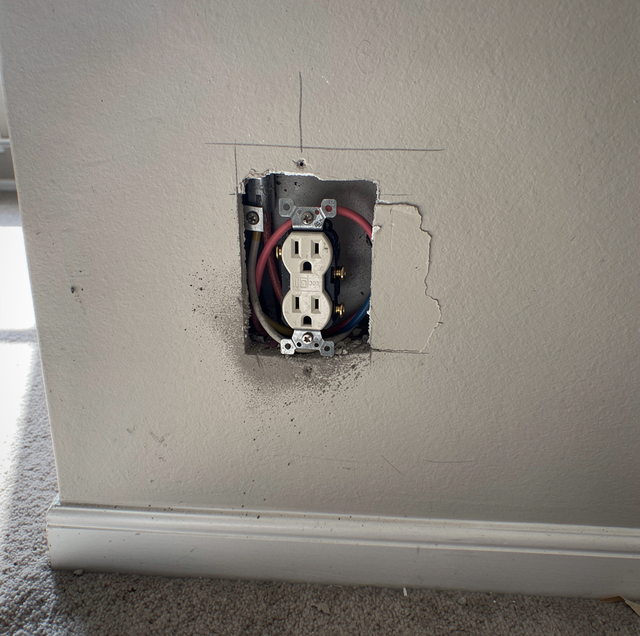
Your outlet is not fastened to your wall. It hangs on a box nailed to a stud behind your drywall, fed by cable stapled along framing on a route you have never seen. When you ask to move it four feet, you are not buying a receptacle. You are buying access to a cavity that was closed and finished long ago.
So yes, you can move an outlet after the drywall is up, and yes, an electrician does it without gutting your room. What you are really deciding is how much access your particular wall will demand, because your framing, your insulation, and whatever else shares that bay shape the scope before anyone touches your paint or your baseboard.
Why an Outlet Ends Up in the Wrong Spot
Outlet placement is a design decision, not an accident. At rough-in, before any drywall goes on, an electrician lays out receptacle locations and heights along each wall so the finished room has power where a household will reach for it. The catch is that rough-in happens while the room is a skeleton. Nobody knows yet that the television will hang on the long wall at fifty-eight inches, that the bed will end up under the window, or that a desk will claim the corner where the only receptacle sits ten inches off the floor.
Remodeling work exists to close that gap. Adding outlets, switches, and circuits in the spots a family uses today is ordinary remodeling scope, and relocating an existing receptacle is the same job in reverse: the circuit and the device already exist, and only the far end of the cable changes address. So the question you are really asking is not whether an outlet can move. It is how much access your wall will demand before it lets one move.
What Stalls a Relocation Once the Wall Is Closed?
The obstruction that most often turns a simple move into a two-opening job is a fire block: a short horizontal piece of framing nailed across a stud bay, put there to slow a fire from running up the inside of a wall. You cannot see it, a stud finder will not reliably call it out, and a fish tape sliding down a bay stops dead against it with nothing at the cover plate to separate a fire block from a horizontal brace, a duct run, or a drain line sharing the same cavity. Insulation does the same thing more quietly. Fiberglass batts grab a tape and bunch up ahead of it, and a cavity packed with blown-in cellulose has no free space left to push anything through at all, which is why the same move on an exterior wall is a different proposition from that move on an interior one.
Direction matters as much as distance. Sliding a box sideways within a single stud bay, or straight up or down, keeps the cable within a single open channel. Crossing a stud does not: the cable has to pass through the stud itself, which means a hole drilled through solid framing, a protective nail plate over it, and access at every stud between the old box and the new one. Twelve inches across two studs can be more work than four feet along one bay.
Never open a finished wall or probe a stud bay to chase a cable yourself, because another circuit in that cavity can still be live: a licensed electrician de-energizes every conductor there and verifies it dead first.
The last thing a closed cavity hides is what else is already in it. Remodeling work routinely turns up damaged wiring, poor grounding, and earlier installations done wrong, all concealed inside walls and ceilings until something opens them. A relocation is a small job that occasionally finds a much larger one, and no one can rule that out from the outside.
Why the Box Itself Has to Change
The box on your wall now is almost certainly a new-work box, built to be nailed or screwed to the face of a stud while that stud is still exposed. No exposed studs are left to nail to once the drywall is finished, so the new opening gets an old-work box, sometimes called a remodel box, which grips the drywall itself with swing-out ears or spring flanges instead of fastening to the framing.
That changes what the new location offers. An old-work box is only as solid as the board holding it, so it needs sound drywall all around the cut and cannot sit where the paper is torn, where an old patch went soft, or where a stud sits behind the spot you picked. Shift it two inches, and it works; leave it where it was marked and the box has nothing to bite.
Depth and fill matter just as much. Incorrect box fill calculations are on the same list of amateur mistakes as reversed polarity and loose terminal screws. Box fill is how many conductors, clamps, devices, and grounds a box of a given cubic-inch volume can hold. Old-work boxes are often shallower than the nail-on box being abandoned, so a splice that sat comfortably in the old one can be over the limit in the new one.
The Box You Leave Behind
A relocated outlet leaves an old box behind, and there are only two honest ends for it. Either the cable is pulled back to its origin, and the box comes out with it, leaving a plain drywall patch, or the cable stays in place, and the old box becomes a junction point where the splice to the new run is made.
If the box stays, it stays reachable. A junction box holding live splices cannot be buried behind new drywall, mudded over, or hidden under a picture; it keeps a blank cover plate and stays openable for good. A buried box surfaces years later during an inspection or a fault chase, when somebody opens a wall to find a splice nobody wrote down. A blank plate on a finished wall looks like an oversight. It is the opposite.
What Else Can Solve the Same Problem
Moving the outlet is not always the least invasive answer. Adding a second receptacle on the same circuit close to where you want power, instead of relocating the one you have, often means one new opening and no abandoned box at all, because the existing device stays live in its own box and simply feeds the new one.
Surface raceway is the other route people underrate. A slim channel runs from the existing box along the baseboard to a new device at the height you want, fastened to the finished surface, with nothing to patch. It is visible, which rules it out for some rooms, and it is hard to beat in a finished basement wall or on masonry, where there is no cavity to work in anyway.
Timing beats technique more often than either. If a room is already scheduled for new flooring, a ceiling opened from below, or cabinets coming off, the same relocation needs a fraction of the opening it would otherwise take. If you know an outlet sits in the wrong place, say so before the drywall on your next project goes up, not after.
How an Electrician Scopes a Move Before Anything Opens
Nothing gets opened until the wall has been worked out on paper. An electrician traces the circuit feeding the existing box back toward the panel, confirms which bay the cable occupies and which direction it runs, checks what else shares that cavity, and only then picks where the new opening goes and whether an access point between the two is unavoidable.
Duration follows from that, not from the distance across the wall. A single installation swapping a device into an existing box typically takes 30 minutes to an hour; adding new circuits or running wire through walls takes longer, and how much longer depends on what the route turns out to entail. An electrician who gives you a firm answer before looking at your wall is guessing.
Most electrical remodeling projects require permits from local authorities and an inspection once the work is finished, and the contractor handles the applications and schedules the inspections. Expect drywall patches at every opening, taped and ready for paint but not painted, since painting sits outside electrical scope. Ask in advance where those patches will land, because that is part of the scope you agree to.
Frequently Asked Questions
Yes, and your electrician will usually pair it with a recessed box so the plug sits flush and your screen still lies tight to your wall. Ask for a separate low-voltage opening beside it for your signal cables, because power and data should not share one cavity opening in a finished wall.
Not cut out. An access opening is made at the block itself; the framing gets bored or notched just enough for your cable, a protective plate goes over the spot so no future fastener can reach the wire, and the opening is patched behind you. That is why one block can turn your single hole into three openings.
Close, but a switch carries more variables. A single-pole switch may hold a switch leg and a neutral, while one leg of a three-way carries travelers, so your new box has to take more conductors than a receptacle box would. If your switch runs a dimmer, the load it feeds has to suit whatever replacement you end up putting on your wall.
Partly from where your wall is: exterior walls are insulated in nearly every home built in the last fifty years, and interior partitions usually are not, unless someone insulated your partition for sound. The rest comes from the box you already have, since once the circuit is dead and the device is out of it, batt facing or loose fill is visible at your opening.
Your opening gets backed, filled, and taped. A small hole takes a mesh patch; anything wider than a couple of inches needs a solid backer screwed behind the board first, or your compound has nothing to hold, and it cracks along the edge within a season. On a textured wall, ask whether your texture will be matched, because matching an orange peel or a knockdown finish is a skill you should agree on.
You should see a device in its new spot, flush and level under a cover plate, and a patch at the old spot taped, sanded, and ready for your painter. If the old box stayed as a junction, a blank plate marks it, and that plate is deliberate.
Months later, your outlet can go dead, and it looks like a bad receptacle. Replace the device and nothing changes, because the loose joint sits three feet away in the old box under its blank plate, where nobody thinks to look. The move was sound; the splice it left behind ages, and you want that box reachable.
Planning a remodel that finally puts power where you actually use it — get the wall, the box, the cable route and the patchwork scoped end to end by a licensed electrician before anyone opens a finished surface. The Plug Electrical Services serves Corpus Christi, Odem, and Portland. Call (361) 282-3058.
