
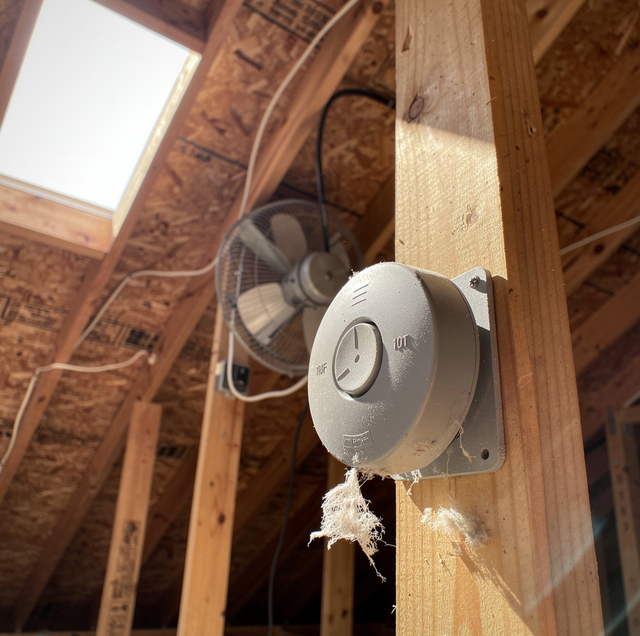
Roof decking baking under direct summer sun can push attic air well past 130°F by early afternoon, and a powered attic fan exists specifically to run flat out in that heat. When the fan goes silent on the hottest day of the year, the failure is rarely dramatic. Every part built into the assembly to survive extreme heat is a candidate for exactly what just quit, and the five likeliest culprits sit in a specific order: the ones you can rule out without a ladder, and the ones that need somebody standing on the joists.
The Thermostat That Fails Before the Motor Ever Gets Power
A powered attic fan switches on through a line-voltage thermostat wired directly into its power feed. Inside it, a bimetallic disc bends as it warms, and at a set temperature, it snaps, sending power to the motor. Factory presets commonly sit in the 100°F to 130°F range, with adjustable units dialing anywhere from about 80°F to 140°F.
That disc is a mechanical part, and it ages. Years of full-range thermal cycling can leave the bimetal fatigued enough that it takes a higher temperature to snap than it used to, so the attic climbs past the point where the fan should have started, and the disc stays open. The second failure sits at the contacts that the disc closes. They carry the motor's full running current every time the fan starts, and years of arcing in attic humidity leave them pitted and corroded enough to add real resistance in that path. The disc can close right on schedule, and the motor still gets less than it needs to spin up: the fan hums, starts weakly, or does nothing at all.
That is what makes this component different from the other four. A fan that sits silent, or hums without turning, on the hottest afternoon gives a homeowner almost nothing to go on, which is exactly why it belongs first on the list rather than last.
When the Motor Shuts Itself Off to Protect Its Windings
Once the thermostat closes, the motor becomes the next part asked to run at the edge of its rating. Small attic fan motors carry a built-in thermal-overload switch wired in series with the windings, separate from the household breaker. That switch exists to open the circuit before the winding insulation breaks down, typically once internal temperature climbs into the 200°F range, and it resets automatically once the motor cools by several tens of degrees.
In an attic already sitting near 150°F, a motor's own resistive heating adds to the ambient air and pushes the winding temperature toward its cutout faster than the same motor would ever see in a garage. Run it through several hours of the hottest part of the day, and the cumulative heat crosses that threshold. The switch opens, the fan stops, and the motor sits without power until it cools enough for the switch to close again, often not until the attic drops back down overnight.
That mechanism produces a specific, recognizable pattern: a fan that runs fine first thing in the morning, quits sometime in the early-to-mid afternoon, and is running the next morning again as if nothing happened. Nothing broke. The motor did exactly what it was built to do, and doing it earlier in the day than it used to is itself worth noting.
Bearings and an Unbalanced Blade Pull the Cutoff Point Earlier
The overload switch responds to how hot the windings get, and heat in a motor is largely a function of current draw. A motor working against extra mechanical resistance draws more current to maintain the same speed, and that extra current appears as heat in the windings before it appears elsewhere. Two things commonly load a motor that way: dry bearings and an unbalanced blade.
Attic fan motors are often built with sleeve bearings supported by an oil-soaked wick rather than sealed ball bearings, and that oil dries out in the same heat, stressing the rest of the assembly. A dry sleeve bearing adds friction the motor has to overcome on every rotation. A blade that has picked up an uneven coat of dust, lost a balancing clip, or bent slightly at one tip does something similar, forcing the motor to fight an off-center load with every turn instead of a clean one. That is a different noise problem from a wobbling ceiling fan, which is its own separate fan and its own separate fix.
Both failures announce themselves as noise before they announce themselves as an outage: a grind or squeal from dry bearings, a knock or hum from an out-of-balance blade. A fan that got louder in the weeks before it started cutting out earlier in the day was already drawing the extra current that eventually pushed its overload switch past the edge.
The Circuit or Humidistat Nobody Remembers Is There
Not every silent fan is a thermostat or a motor problem. The circuit feeding the fan is worth checking before either. Attic fans are frequently wired onto a shared circuit with a bath exhaust fan, a garage outlet, or another intermittent load, and a tripped breaker or a tripped GFCI somewhere else on that circuit can cut power to the fan, with no attic symptoms at all. The fan itself is fine; it simply never received power to begin with.
A second, easy-to-forget wrinkle: many powered attic fans are controlled by both a thermostat and a humidistat, wired so the fan needs a signal from one of them before it runs. A homeowner who bought the house after installation, or who never noticed the small humidistat dial mounted near the fan or at the attic access, can spend an afternoon troubleshooting a fan that is simply waiting on a control they don't know exists. If that humidistat has drifted out of calibration the same way a thermostat can, it can hold the circuit open on a day hot and dry enough that the temperature control alone would already have started the fan.
A Fan Starved of Intake Air Ends Up Pulling From the House
The fifth cause does not involve a broken part at all. A powered attic fan works by creating a pressure difference: it exhausts attic air, and outside air is supposed to replace it through soffit vents at the eaves. Fan manufacturers size that intake area to the fan's rated output, commonly calling for roughly one square foot of clear soffit vent opening for every 300 cubic feet per minute the fan is rated to move.
When soffit vents are painted shut, blocked by insulation pushed against the eaves, or simply undersized for the fan installed above them, the fan still runs and pulls air, but it cannot draw enough through the path built for that job. Air under a pressure difference moves toward the easiest opening available. With the soffits choked off, that easiest opening becomes the house itself: recessed light housings, the attic access hatch, plumbing and wiring penetrations. The fan starts drawing conditioned air out of the living space instead of fresh air from outside.
The result reads like a weak or failing fan. The attic stays hot, the fan runs constantly, and nothing seems to improve. Pulling household air that way can also reverse the draft in a naturally vented gas water heater or furnace, bringing combustion products, carbon monoxide among them, back down the flue into the living space. Working CO alarms matter for that reason. A fan running constantly against an attic that stays hot is a reason to have the soffit intake and the appliance venting looked at together. The motor is doing its job; the air path it depends on is what needs attention.
What You Can Check From Inside the House, and What Needs the Attic
Three of the five causes are checkable without a ladder. The time-of-day pattern that marks an overload trip is one of them, and you can note it simply by listening for the fan's hum from a hallway or bedroom below the attic at different times of day. The circuit is checkable at the breaker panel and at any GFCI outlets sharing it, and a humidistat, if one exists, is usually mounted at the attic access or on a nearby wall where you can see it without stepping past the hatch. Soffit intake is the third: painted-over vents and blocked screens usually show from the ground, looking up at the underside of the eaves.
Attic air can top 150°F in early afternoon, footing exists only on the ceiling joists, and a fan can restart the instant its thermostat closes or its overload resets. Shut off the fan's breaker or disconnect before working near it.
Confirming the other two takes going up. Telling a drifted thermostat from one that is still working means testing it against a known temperature at the fan itself, and telling worn bearings or an unbalanced blade from a normal-sounding motor means listening and looking at the assembly up close.
| Symptom | Likely part | Confirm from |
|---|---|---|
| Silent or humming on the hottest day, no warning noise before it | Thermostat | The attic, at the fan |
| Runs mornings, quits afternoons, resets by the next day | Motor's overload switch | Inside, by tracking the time pattern |
| Got louder before it got unreliable | Bearings or blade | The attic, at the fan |
| Fan never starts, or a breaker won't stay reset | Circuit or humidistat | Inside, at the panel and GFCIs |
| Runs constantly, attic still hot | Soffit intake | The attic eaves, or the soffits from outside |
Frequently Asked Questions
Yes. If the thermostat's contacts weld shut instead of drifting open, the fan keeps receiving power even after the attic has cooled well below the set point, so it runs through the night or on a mild day when nothing calls for it. That wastes electricity and puts more hours on the motor and bearings than they were built for, and it traces to the same worn switch as a fan that won't start, just failed in the opposite direction.
Not entirely. Many solar-powered attic fans skip the household circuit and the line-voltage thermostat altogether, wiring the motor straight to a small rooftop photovoltaic panel, so the fan speeds up and slows down with the sunlight hitting that panel rather than with attic temperature. A solar fan running slowly under a cloud bank is behaving as designed, its output tracking the panel rather than the failures described above.
Many gable- or roof-mounted attic fans use a shaded-pole or permanent split-capacitor motor rated at 1/8 to 1/4 horsepower, which draws about 2 to 5 amps on a standard 120-volt circuit. That is a small enough load that the fan is rarely the sole reason a shared circuit trips under normal conditions.
It depends on the motor. Some attic fan housings have a small built-in oil port for a few drops of standard electric motor oil about once a year, which keeps a sleeve bearing running smoothly well past the point at which it would otherwise dry out. Others use sealed bearings with no service point at all, and on those units a bearing that has started grinding is a replacement, not a maintenance item.
Often, yes. A roof-mounted fan sits in a curb built into the decking with its motor directly under sun-facing shingles, while a gable-mounted fan sits behind louvers on the vertical end wall of the attic, shaded from direct sun for more of the day. The roof-mounted motor typically runs hotter for longer stretches, so the same thermal-overload pattern tends to show up earlier in the afternoon on a roof-mounted unit than on a gable-mounted one nearby.
A smaller share of attic fan motors use a manual-reset thermal cutout rather than an automatic one, and that switch stays open overnight until something resets it. A fan that behaved normally for years and then simply never restarts the next morning, with no other symptoms, is as likely to have this different switch type as it is to have a dead motor.
Schedule an attic fan inspection — a licensed electrician can test the thermostat, the motor's overload switch, and the circuit feeding it in one visit. The Plug Electrical Services serves Corpus Christi, Odem, and Portland. Call (361) 282-3058.
