
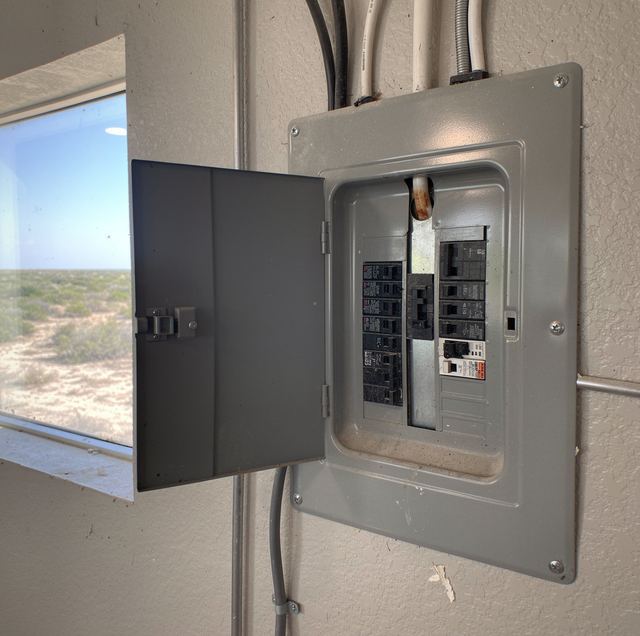
A circuit breaker has no expiration date printed on it. It lasts until a part inside it gives out: the contacts that carry the current, the sensing element, and the spring-and-latch mechanism that snap them apart, or the metal clip that grips the panel's bus bar. A breaker in a dry indoor panel with few trips and moderate loads can continue to work for decades. One that has cleared heavy faults, run hot at a loose connection, or sat in a damp enclosure can wear out early. An old breaker earns a look on age, and age is not proof that it has failed. Condition determines your breaker's answer, and that condition shows up in a handful of signs you can read from outside the panel.
What Wears a Breaker Out
A breaker is a switch with a sensor attached, and each part wears down in its own way.
Trips: When a breaker opens under load, an arc jumps between the contacts as they pull apart. That arc is hot enough to pit and erode the contact faces, and the damage follows the size of the current being cut. A mild overload leaves light marks; clearing a short circuit, with its sudden surge, can badly burn the faces in a single event. Eroded contacts meet over a smaller, rougher surface, and a smaller contact area offers more resistance to current, which turns into heat inside the breaker. Whatever set off the trip, each one takes that toll on the contacts.
Heat at the connection: A breaker connects to the rest of your system at two points: the terminal screw that holds the branch wire and the clip that presses onto the bus bar. Each load cycle warms and cools those joints, and over years the metal can relax its grip. A loose joint resists current; the resistance generates heat, which oxidizes the metal, raising the resistance again. Once that loop starts, it feeds itself until someone breaks it.
Age of the mechanism: Inside the case, a spring holds the contacts closed, and a latch releases them when the sensing element calls for a trip. The spring can weaken, the latch can stiffen, and the handle can lose the firm snap it had when the breaker was new.
Corrosion: Moisture that reaches a panel, from a roof leak above it, condensation, or a damp garage, leaves a film of oxide on terminals and on the bus clip. Oxide resists current, so corrosion brings the breaker straight back to the heat problem at its connections.
Signs a Breaker Is Failing
Several signs appear at the panel door, without anyone touching the parts behind the inner cover.
- It will not reset: The handle springs back to the tripped position, even after you unplug everything on that circuit. One attempt is the limit. A breaker that refuses to stay on is never held, taped, or forced into the on position, because a breaker that will not latch may be sitting on a fault it is doing its job to stop.
- It trips with nothing running: A trip on a quiet circuit points either at the breaker's own mechanism or at a fault somewhere on the wiring, and telling the two apart takes testing.
- It is hot: A breaker handle or panel door that feels hot when you open it to reset something can mean heat is building at a connection or at worn contacts inside the breaker. That is a call-now sign.
- It buzzes: A steady buzz or crackle from one breaker can come from arcing at its contacts, its terminal, or its bus clip. Call now; do not wait to see whether it stops.
- It shows scorch marks: Brown or black marks on the breaker body, on the plastic around its slot, or on the wire insulation at its terminal mean something has already overheated. Call now, and keep loads off that circuit.
- The handle feels wrong: A handle that wobbles or moves without a click, on a breaker that has not tripped, can mean the latch or spring inside has worn.
Keep the inner panel cover in place with the main breaker off, because the main's conductors stay energized from the utility side and can deliver a fatal shock. Removing it, reseating a breaker, or tightening a terminal is the job of a licensed electrician.
Breaker or Panel: Where the Fault Sits
A failing breaker and a failing panel can show the same symptom, and the difference decides the repair. The breaker is the likely suspect when one breaker shows the problem and its neighbors run cool and quiet. The panel comes into question when the trouble spreads across the box: several breakers warm at once, buzzing that cannot be traced to a single slot, or a main breaker that runs hot.
The bus bar is where the two overlap. When a breaker's clip loosens and arcs against the bus, the arc burns the bus finger it grips as well as the breaker. A new breaker pressed onto a pitted, blackened finger starts life on a damaged contact, and the heat can return. So a scorched breaker raises a question about the metal underneath it, and the answer to that question is what separates a breaker job from a panel job.
Inside a panel with enough capacity for the house, replacing a worn breaker restores its protection without changing what the panel can carry.
Replacing One Breaker or Upgrading the Panel
When one breaker has failed, the bus beneath it is clean, and the panel is sound, the repair is a replacement breaker of the same type and rating, installed in the same slot. That is circuit breaker service in its simplest form, and it leaves the rest of the panel untouched.
The decision moves toward panel repair or replacement when one of these conditions holds:
- The bus is damaged at the slot, so no new breaker can make a sound connection there.
- Several breakers in the same panel show heat, scorching, or worn mechanisms, which points past any single part.
- A matching replacement for the breakers in that panel can no longer be found.
- The panel shows corrosion across its bus and lugs, not only on one breaker.
That last condition is where location enters the decision. An outdoor panel or a disconnect box beside an air conditioner or pool equipment draws in outside air every day. Where that air carries salt, the salt attacks the lugs, the breaker's terminal screw, and the clip on the bus, and a corroded contact resists current and heats. A breaker that fails in an outdoor enclosure exposed to salt is judged together with its enclosure: if the bus clip and lugs carry the same crust, a new breaker pressed onto them inherits the bad contact, and replacing the enclosure or the panel is the repair that holds. Where salt does not reach the enclosure, the corrosion inside it remains light, and an outdoor breaker is judged by the same wear as an indoor one: its trip history, heat at its terminals, and the state of its mechanism.
For an indoor panel in dry air, the same logic applies without the salt. One worn breaker on sound metal gets replaced, and damage that reaches the bus or spreads across the panel moves the job to the panel.
Symptom, Suspect and Next Step
Each symptom in this chart points to a likely part and a response that fits it.
| Symptom | Breaker or panel | What happens next |
|---|---|---|
| Handle springs back even with the circuit unloaded | Breaker, or a fault on its circuit | One attempt only; the circuit and breaker get tested |
| Trips on a circuit with nothing running | Breaker mechanism or a wiring fault | Circuit ruled out first, then the breaker judged |
| One breaker hot while its neighbors stay cool | Breaker or its bus connection | Call now; the breaker and bus finger get inspected |
| Several breakers warm, or buzzing across the box | Panel | Call now; panel repair or replacement weighed |
| Scorching on a breaker or around its slot | Breaker, with possible bus damage | Call now; bus condition picks a swap or a panel job |
| Crust or rust inside an outdoor disconnect | Enclosure, lugs and breaker | All three checked together |
| Handle loose or without a click | Breaker mechanism | That breaker replaced |
Frequently Asked Questions
In some cases, yes, with an infrared camera. Scanning the panel while the circuits carry their normal load shows heat as color, so a breaker or terminal running hotter than the ones beside it stands out even when it looks clean and the handle feels firm. A scan with the circuits idle shows little, because the heat only builds under current.
No. The number on the handle is the current it is sized to protect, and it stays the same for the life of the part. Age shows in other ways: a date code or a series marking on the side label that an electrician can read, a case that has yellowed or gone brittle, and a handle that no longer snaps crisply between positions.
It can be, and it can also be damaged without showing it. Every breaker carries an interrupting rating on its label, the largest fault current it is built to cut safely, and on some residential breakers that figure is 10,000 amps. A short that pushes current toward that limit can weld or badly erode the contacts, so a breaker that has cleared a hard short deserves a check even if it resets and holds.
Fitting the slot is not the test. The label inside the panel door lists the breaker types tested for that panel's bus, and a replacement should come from that list. Some replacement breakers are sold as classified for specific panels, meaning they were tested for use on that bus, and the breaker's own label names the panels it covers.
It could be one cause. An electric dryer's heating element operates at 240 volts across both poles of a double-pole breaker, while the drum motor operates at 120 volts from one pole. If one pole of the breaker loses contact, the drum can still turn with no heat. A failed heating element, a blown thermal fuse in the dryer, or a loose connection at the dryer's receptacle can produce the same result.
A breaker switched on and off every day is doing a job it may not be rated for. Breakers built for regular switching of lighting circuits carry an SWD marking, short for switching duty, on the label. One without that marking is meant to be operated occasionally, and if you need to switch a circuit daily, a wall switch or a dedicated control is the right part.
Arrange circuit breaker service for a breaker that runs hot, buzzes, or will not hold — the repair is matched to what the bus and panel show, from one breaker to a panel repair. The Plug Electrical Services serves Corpus Christi, Odem, and Portland. Call (361) 282-3058.
