
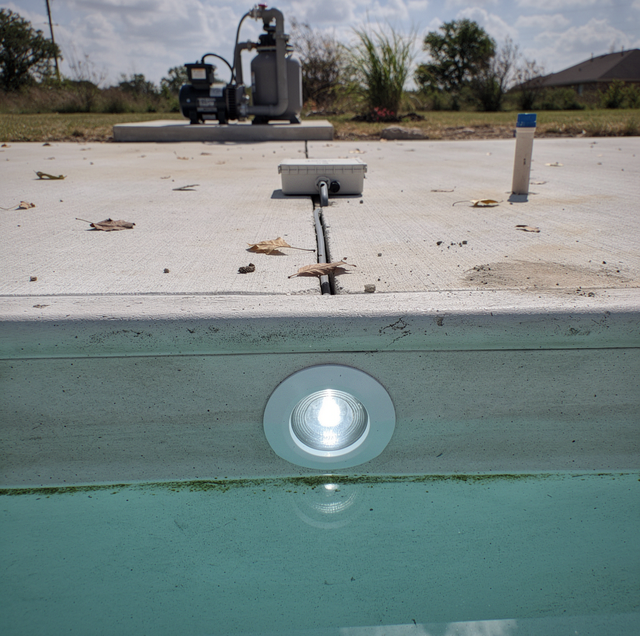
The pool light worked last night. Tonight you flip the switch, the light flickers or never comes on, and a GFCI somewhere in the house snaps off. A GFCI is built to open when it measures current leaving the light's circuit by a path it was never meant to take, and on a pool light, that path can run through the water people swim in. Finding the cause means following the circuit from the fixture in the pool wall, back through the deck, to the device that shut it off.
How a Pool Light Is Built and Where the GFCI Sits
A standard in-pool light is a wet-niche fixture. The lamp sits inside a sealed housing, with a lens clamped down over a rubber gasket, and that housing mounts in a niche: a bowl-shaped shell set into the pool wall. Pool water fills the niche around the housing by design. The lens, the gasket, and the housing around them are what keep water away from the lamp, its socket, and its wiring.
From the back of the niche, a jacketed cord carrying a hot conductor, a neutral, and a grounding conductor runs through conduit buried under the deck. The conduit is open to the pool at the niche end, so it holds pool water up to the pool's water level, and the cord's jacket and insulation keep that water off the copper. The conduit ends at a junction box on the deck, raised above the waterline and set back from the edge, where the cord is spliced to wiring coming from the house.
Some lights run on 120 volts all the way down to the lamp. Others run on 12 volts, fed by a transformer mounted near the equipment pad or on a wall of the house, which takes 120 volts on its input side and hands low voltage to the pool cord on its output side.
The GFCI sits upstream of all of it, on the 120-volt circuit, either as a breaker in a panel or as a GFCI device ahead of the light's switch. It compares the current flowing out on the hot conductor with the current returning on the neutral, and when some of it fails to return, it opens the circuit. On a 120-volt light, that comparison covers every foot of wire down to the lamp. On a 12-volt light, it covers the wiring up to the transformer and the transformer's own input winding, and that boundary matters for one of the trips below.
Keep everyone out of the pool until the fault is found; a shock in the water can lock a swimmer's muscles and cause drowning. Never reset the GFCI repeatedly, bypass it, or pull the light. A licensed electrician tests it first.
Water in the Fixture and Damage Along the Cord
The two leak paths closest to the water start at the fixture itself.
Water inside the housing: The gasket between lens and housing is rubber, and rubber hardens and takes a set with age, heat, and pool chemicals. Once it stops sealing, water seeps into the housing and wets the lamp socket, where it bridges the energized terminals and the fixture's grounded metal. Current crossing that wet path returns through the ground rather than the neutral, and the GFCI detects the shortfall. A cracked lens or a clamp screw that has backed off lets water in the same way.
A damaged cord: The cord spends its whole life submerged in the conduit, so a split in its jacket puts pool water on the conductor insulation, and a break in that insulation puts water on copper. Cords chafe where they pass through the niche's cord entry, and a conduit crushed under the deck can pinch the cord inside it. From the deck, none of this is visible because the damaged stretch lies underground and underwater.
Both paths put an energized conductor in contact with water that connects to the pool. That is exactly the situation the GFCI is designed to interrupt, which is why a trip from a pool light is treated as a water fault until testing shows it is coming from elsewhere.
If the trips started after a new deck, pavers, a fence post, or a trench for yard lighting went in near the pool, tell the electrician. Digging and slab work can crush the buried conduit or nick the cord running through it.
The Deck Junction Box and Its Splices
The junction box is where the pool cord meets the house wiring, with the connections secured by wire connectors inside a box whose lid seals against its own gasket. Its height is the protection: the water standing in the conduit stays below the splices as long as the box sits above the pool's water level.
Water can defeat that from two directions. It can come in from above, through a cracked lid, a failed lid gasket, or a box that sprinkler spray and runoff reach. It can also rise from below when the pool is overfilled or when the box was set too low, pushing conduit water up toward the connections.
Corrosion is the third route, and whether it matters depends on the air the box lives in. Salt carried in the air settles on terminal screws, connector springs, and any metal in the box and eats into them, and the salty crust it leaves conducts once it turns damp. That gives current a path from a hot splice to the grounded box with no standing water involved, so where salt air reaches the box, an electrician opening it after a trip checks the metal as closely as the seals. Where neither salt air nor splash from a salt-chlorinated pool reaches the box, corrosion there stays slight, and the search turns instead to the lid gasket, the conduit openings, and the pool's water level.
Tracing a Trip Back to the Transformer
For a 12-volt light, the transformer changes what a trip means. Its input and output are separate windings with no wire connecting them; power crosses between them through the magnetic core. A leak on the 12-volt side, in the pool cord or the fixture, returns to the output winding and not to the 120-volt circuit while the transformer is intact, so the GFCI on the input side has no imbalance to measure.
That means a GFCI trip on a 12-volt light circuit sends the search to the 120-volt side first:
- The transformer's input winding, if moisture or damage inside its enclosure has let it leak to the grounded case.
- The supply wiring and connections between the GFCI and the transformer.
- Any other load wired on the same GFCI, such as a deck receptacle or yard lights.
- A transformer that has broken down internally so its two windings touch, which lets a leak in the pool reach the GFCI but is still a transformer failure.
A 12-volt fixture can still have water inside it without tripping anything. That is one reason a light that has gone dim, dead, or flickery gets checked even when no GFCI has tripped.
Reading the Timing of the Trip
When the trip happens narrows the list. It does not settle it, since two faults can share one timing pattern.
| When it trips | Where the timing points |
|---|---|
| The instant the light switches on | A leak present all the time: water already in the housing, a cord with broken insulation or a wet splice |
| After the light has been on for a while | A fault that worsens with heat, such as moisture already in the housing or a lamp socket breaking down as it warms |
| After rain, sprinklers or topping off the pool | Water reaching the junction box or transformer from above, or conduit water rising toward the splices |
| At random, with no pattern | A loose or corroded connection, another load sharing the same GFCI, or a GFCI device that has failed |
The heat-driven case deserves a closer look. A lamp warms its sealed housing each time it runs, drawing water past a marginal seal as it cools afterward, and moisture already inside can hold off until the socket heats and then leak enough to trip. That fault can hold a reset for a while and then trip, making it easy to mistake it for a random one.
The rain-driven case works the same way in reverse. A box that holds between storms and trips, with water getting in from outside, and it can look fine through every dry spell in between.
Why the Light Stays Off Until It's Tested
A reset that holds shows only that no leak is flowing at that moment. Moisture that leaks only once the socket warms, or a box that takes on water after a storm, will hold on a dry afternoon and trip again the next time conditions line up. The damaged part is still there between trips.
The GFCI is the device standing between that damaged part and the water. Each reset re-energizes the circuit while the fault remains, prompting the GFCI to trip again. Replacing the GFCI with a standard breaker or wiring around it removes the one device on the circuit that responds to leakage at all, since a standard breaker opens on overload and short circuit, not on current escaping into water. Lifting the fixture out of its niche to inspect it brings a possibly energized housing and a possibly damaged cord out of the water and into your hands.
Testing breaks the circuit into pieces. With power off, an electrician isolates the light from the rest of the circuit and checks the fixture and cord, the junction box splices, the transformer if there is one, and the supply wiring as separate sections. The result identifies the failing part: a housing that needs a new seal or lamp, a cord that needs replacing, a junction box that needs new splices or a new position, a transformer that has failed, or a supply fault on the house side. If anyone has felt a tingle in the water, or near the ladder or rails, say so when you call, because it changes how the circuit gets approached.
Frequently Asked Questions
No. The water surrounding the housing is what carries away the lamp's heat, so an in-pool light should never run out of water. Lit dry, an incandescent or halogen lamp can overheat the housing, crack the lens, or damage the gasket, which sets up a water leak the moment the pool is refilled.
Resurfacing and replastering crews take the light out of its niche and set it back in afterward. Every reinstall disturbs the lens seal and can kink or pinch the cord where it exits the niche, so a trip that begins right after that work puts the reinstall on the list alongside any older wear.
The cord is left long on purpose, with a coil of slack stored behind the fixture inside the niche. That slack lets an electrician float the fixture up to the deck for service while the pool stays full. A cord cut short during an earlier repair can mean draining the pool or replacing the cord the next time the light needs work.
On a correctly wired circuit, the switch breaks the hot conductor, so with it off, the pool cord and fixture carry no power to leak. A trip with the light switched off points to wiring between the GFCI and the switch, to another load on the same GFCI, to a switch wired on the neutral instead of the hot, or to the GFCI device itself, and that narrows the search before anyone opens the junction box.
A metal niche has a bonding lug on its outside that ties it to the pool's bonding wire, separate from the grounding conductor in the light's cord. Plastic niches have no metal to bond. An electrician checks that lug connection when the light is serviced, since a broken bond leaves the niche out of the pool's bonding system.
An insulation resistance test. With the circuit de-energized and the cord disconnected at the junction box, a meter applies a DC test voltage between each conductor and ground and reads the resistance in megohms. A healthy cord reads high; a low reading shows water or damage in the insulation, even when the cord looks fine where it can be seen.
Pool light knocking out its GFCI again — get the fixture, cord, junction box, and transformer tested by a licensed electrician before anyone swims. The Plug Electrical Services serves Corpus Christi, Odem, and Portland. Call (361) 282-3058.
