
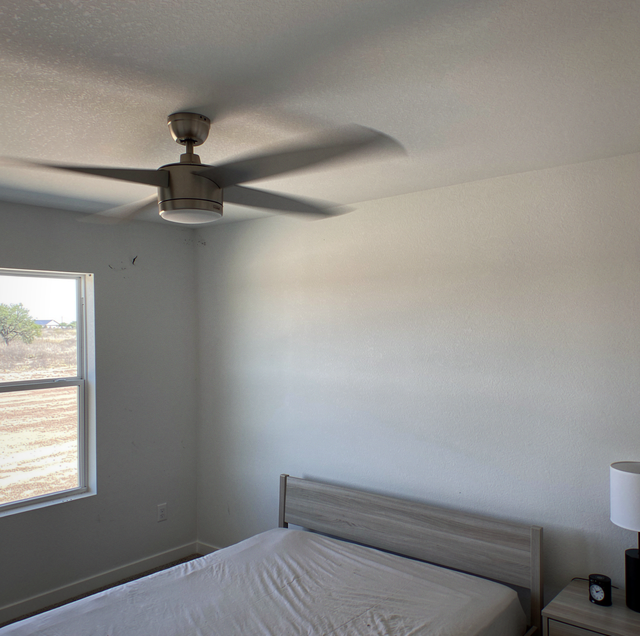
Your ceiling fan is either turning above someone right now or turning above an empty room. A fan moves air past people and leaves the temperature of the room it hangs in where it was, so those two cases are not two settings of one benefit. One of them is the benefit and the other is a motor running for nobody.
The second thing you can answer from where you are standing is which way the blades are turning, and that answer belongs to the season rather than the afternoon. Both checks take about ten seconds. Behind them sits a piece of physics that gets more interesting once the air in the room is already carrying a great deal of water.
The Fan Moves Air and Removes No Heat From the Room
The blades push a column of air downward, and the room's air circles back up around the edges, so the same air keeps going around, and none of it leaves the house. An air conditioner lowers a room's temperature by carrying heat out through a coil and a condenser. A fan has no path out of the room and carries no heat anywhere. Fans cool people, not rooms, so turn a ceiling fan off when you leave the room. Everything below sits on that.
The motor is the other half of the honesty. It draws power to turn the blades, and the friction and winding losses that come with turning them end up as heat in that same room. Efficiency ratings for ceiling fans are given in cubic feet of air a minute for each watt drawn, so the watt figure is on the specification sheet where you can find it. Over the course of an afternoon, a fan left running in an empty room has warmed the room slightly rather than cooled it, and nobody is standing in the airstream to collect the one benefit it produces. So the empty-room case is not a neutral one. It runs the wrong way slightly.
Moving Air Strips the Warm, Damp Layer Off You
In still air, a thin layer sits against your skin and stops behaving as room air. It warms toward your own surface temperature and takes on water vapor from whatever your skin is giving off, until it is both warmer and wetter than the air a foot away. Two transfers run through that layer at once. Heat moves out of you into air cooler than you are, and water leaves your skin as vapor, carrying its latent heat with it. Each transfer depends on a difference: temperature for the first and water vapor for the second. As the layer warms and dampens, both differences shrink and both transfers slow.
Moving air replaces that layer continuously. Fresh room air arrives against your skin; the temperature difference returns, the water vapor difference returns, and both transfers resume at nearly full rate. Efficiency-rating guidance on running a ceiling fan year-round calls the warm-weather result a wind-chill effect. Notice what has not happened. The heat that left your body went into the room's air, where it still is. A house full of running fans ends the day marginally warmer, and everyone standing under one is more comfortable.
Humid Air Accepts Less of What Your Skin Gives Up
Follow one layer of air outward from your skin, because each step along that path holds a different piece of the humid-air case, and they do not point the same way.
At the skin, how fast sweat evaporates depends on how much water the surrounding air can hold relative to the saturated air at the wet surface. Air carrying a great deal of water narrows that difference, and evaporation slows in proportion.
One step out, the fan still works. The layer against motionless skin saturates faster than any air in the room, so whatever the fan brings in is the driest air available to it, however damp that air is by any other measure. Moving air restores part of the difference the humidity narrowed. That same guidance says you should feel a cool breeze standing directly under the fan, and in damp air you still do.
One step further out, the heat side is untouched. Heat moving from your skin into cooler air depends on the temperature difference, and that difference is independent of the air's water content. In humid air, the evaporative half of a fan's effect shrinks, and the convective half does not.
None of this holds past a point. Everything above assumes the room's air is cooler than you are, and a hot enough room ends that assumption. The fan keeps doing what it did, and what you feel stops tracking what is happening to you.
Federal guidance on extreme heat and indoor air quality directs that electric fans not be used for cooling once a room is in the mid-90s or hotter, because a fan will not prevent heat-related illness. Cooler air is the answer.
Four Degrees on the Thermostat, and What It Describes
About 4 °F is the figure federal energy guidance assigns to a ceiling fan, and the conditions are outlined in the same statement: if you use air conditioning, a ceiling fan will let you raise the thermostat setting by about 4 °F with no reduction in comfort. Read the conditions as part of the figure: the air conditioning is running, and the comfort being described is yours, in that room, under that fan.
So the figure is about a person in a room, and the room's own air temperature is untouched by it. It does not mean an unconditioned room ends up four degrees cooler with the fan on, because the room's air does not move in that direction at all. It means you stay as comfortable at a higher thermostat setting, in moving air, as you were at a lower one with the air still.
It closes the loop on the empty room too, since a fan produces its effect only where a person stands in the moving air and an empty room is not that place. And it is a warm-weather figure. It says nothing about a heating season, when what you want out of a fan changes entirely.
Higher Blade Pitch Does Not Always Move More Air
Thirty-six inches of blade span marks where the efficiency-rating criteria change formula. Below that span, the threshold is 1.44D plus 83.86 cubic feet per minute per watt; above it, 5.26D minus 53.66, with D the span in inches. Span carries enough weight in how much air a fan moves that it sits inside the equation as a variable, the first of two numbers you find on the sheet.
Pitch is the second, the angle each blade is set at away from horizontal, in degrees on the same sheet. Federal guidance on ceiling fan components states that a higher blade pitch usually moves more air, then adds in the same breath that pitch alone does not determine air movement and a higher pitch is not always better, because some models raise it to make up for a weaker motor. A steep blade on a weak motor can move less air over you than a shallow blade on a strong one.
Neither number describes a temperature. The sheet publishes span in inches and pitch in degrees, and carries no line for how cool your room gets, because the fan produces no effect there to publish. Those two figures describe how much air reaches you sitting under the blades, and nothing about the temperature of the air when it gets there.
Frequently Asked Questions
Because the layer of air against your skin changed while the room's air did not. A dry-bulb thermometer moved into the airstream reads the same as one outside it. A wet-bulb thermometer, its bulb inside a wet wick, falls when air crosses it, because water leaving the wick carries heat away. Your skin runs the wet-bulb version of that, which is why the effect arrives the instant the blades do.
It dries the air, as a side effect of how it cools. The indoor coil operates below the dew point of the air passing over it, so water condenses on the fins and leaves through the condensate line rather than remaining in the room. Drier air widens the water vapor difference your sweat evaporates across, so the evaporative half of a fan's effect comes back closer to full strength.
For comfort, no, and it is the reason to switch one off behind you. For drying, sometimes. The same air movement that pulls vapor off your skin pulls it off a damp floor or a wet wall, so a fan does speed evaporation from a wet surface. Watch where that water ends up. It goes into the room's air rather than out of your house, so you have relocated it, and something else has to remove it.
The heat half of the transfer changes sign. Heat moves only from a warmer surface toward a cooler one, so once the air around you is hotter than your skin, the thermal gradient is negative, and heat flows from the room into your body. Moving that hotter air across you speeds a transfer now running against you, and evaporation is the only channel left in your favor.
No single distance, but the distance names the category. Efficiency-rating criteria define a standard ceiling fan as one whose lowest blade point sits more than ten inches from the ceiling, and a hugger as one where that point is ten inches or less. Both are held to the same efficiency formula, so if you are choosing between them, those ten inches describe how the fan hangs rather than how it performs.
Standard ceiling fan operation calls for blowing air downward, counterclockwise, in warm weather, and upward, clockwise, in winter, so warm air held at the ceiling is spread around the room without a draft. Upward runs at low speed because a breeze you can feel is the thing that direction avoids. The reversing switch is on the switch housing beneath the motor; turn the fan off and let it stop completely before moving it.
Plan the ceiling fan before the drywall goes on — the box that carries a moving load and the bracing behind it go in from above while the ceiling is still open. The Plug Electrical Services serves Corpus Christi, Odem, and Portland. Call (361) 282-3058.