
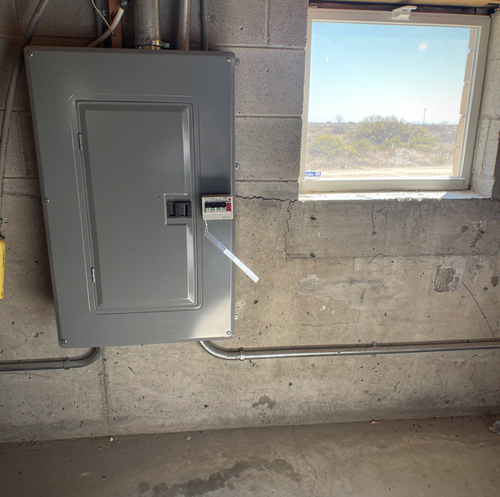
Quick Answer: A whole-house surge protector is a device wired at your electrical panel that senses voltage spikes and diverts the excess energy to ground, protecting appliances and electronics on every circuit before the surge can reach them.
Your home runs on a steady voltage, roughly 120 volts at the outlet, and every device plugged in expects that number to stay put. When the voltage jumps for even a fraction of a second, sensitive electronics take the hit. A whole-house surge protector, wired at the electrical panel, exists to catch that jump and shunt it away before it reaches your circuits. Understanding what a surge actually is, and how the device handles it, makes the value obvious.
What A Surge Actually Is
A surge is a brief spike in voltage that rises well above the normal level, then collapses back within microseconds. The spike carries extra energy that circuits and devices were never built to absorb. A large surge can arrive in under a thousandth of a second, far faster than any switch or fuse you could operate by hand.
Surges come from more sources than most people expect, and only one of them is weather.
Lightning and utility events: A nearby lightning strike does not have to hit your house to cause damage. A strike on a power line or the ground nearby can push a massive spike through the utility feed. The electric utility itself also creates surges when it switches equipment on the grid, reroutes power, or recovers from an outage. These grid switching events happen in every season, day and night, with no storm in sight.
Surges made inside your own walls: The quieter, more constant source is your own home. Large motors draw a heavy jolt of current when they start and release a spike when they stop. An air conditioner compressor, a refrigerator, a well pump, and a furnace blower all cycle on and off around the clock, and each cycle sends a small surge back down the wiring. These internal surges are smaller than a lightning event, but they land dozens of times a day, every day of the year. That steady drip wears down electronics gradually, which is why a device can fail long after any single dramatic event.
How A Panel Surge Protector Clamps The Spike
A whole-house unit is called a surge protective device, or SPD. It mounts at or beside the main electrical panel and connects across the incoming power and the ground. Inside sits a component that behaves in a useful way: at normal voltage it acts like an open door and does nothing, but the instant voltage climbs past a set threshold it turns conductive and opens a path to ground.
That threshold behavior is the whole trick. When a spike arrives, the SPD clamps the voltage, holding it down to a safer level, and diverts the excess energy through the ground wire instead of letting it flow into your circuits. The device reacts in nanoseconds, faster than the surge can travel through the branch wiring to your outlets.
A ceiling drain in a shower shows the idea. Water at a normal level sits harmlessly, but the moment it rises too high, the drain opens and carries the overflow away before it floods the room. The SPD sends surge energy to ground the same way, opening only when the level gets dangerous.
Panel SPDs come in two common forms. A Type 1 device connects on the utility side, ahead of the main breaker, and handles the larger externally driven spikes. A Type 2 device connects on the load side, inside or next to the panel, and is the most common choice for whole-home protection. Both share the same job of clamping and diverting; the difference is where they sit in the system.
Why One Device Plus Strips Beats Either Alone
A panel SPD does an excellent job on the big stuff, but no single device catches everything. Some surge energy is generated past the panel, by motors and equipment already inside the house, and a small remainder of an incoming spike can slip through as a much-reduced ripple. Point-of-use protection handles that leftover.
This is the layered approach. The panel SPD is the first and heaviest layer, knocking a large spike down to a fraction of its original size. A quality plug-in surge strip at the outlet is the second layer, mopping up the reduced spike right at your television, computer, or entertainment system. The strip only has to deal with what the panel let through, so the two layers together protect far better than either does on its own.
Reading the joule and clamping numbers: Two numbers describe a surge device in plain terms. The joule rating is roughly how much total energy the device can absorb over its life before it wears out, so a higher number means more headroom and a longer service life. The clamping voltage, sometimes called the let-through voltage, is the level the device holds the spike down to. A lower clamping voltage means less surge energy reaches your gear. When you shop for a plug-in strip, a higher joule rating paired with a lower clamping voltage is the better combination.
What A Surge Protector Does Not Replace
An SPD is one tool, not a whole toolbox, and it depends on other parts of the system to do its job.
It does not replace grounding. The SPD diverts surge energy into the ground path, so if the home's grounding is faulty or missing, the device has nowhere to send the energy and cannot protect anything. Good grounding is the foundation the SPD stands on.
It also does not replace a UPS, an uninterruptible power supply. A surge device guards against voltage spikes, but it does nothing for the opposite problems: a sag, a brownout, or a full outage. A UPS carries a computer or a medical device through a dip or a blackout on battery power and lets it shut down cleanly. The two devices solve different problems, and a critical system often wants both.
Signs The Device Has Worked Or Needs Replacing
A surge protector is a consumable. Every spike it absorbs uses up a little of its capacity, and after a major event or years of small hits it eventually reaches the end of its life.
When that indicator goes dark or switches to red, the internal element has worn out, and the unit is no longer clamping, even though power still flows to the house normally. A worn SPD gives no other warning, so the light is the only easy way to know.
Most panel SPDs have a status light or window that shows the unit is live. If it goes dark or turns red, the unit has worn out and is no longer clamping, so check it after a big lightning season or a known nearby strike and replace a spent unit to restore protection.
Why This Is Licensed Electrician Work
A panel-mounted SPD wires directly into the electrical panel, where the busbars carry lethal voltage even with the main breaker off in some designs. Opening the panel and landing the device on the correct terminals is licensed electrician work, not a homeowner project. Leave the panel closed and let a professional install and connect the unit.
Plug-in strips are the safe part for a homeowner. They simply plug into an existing outlet, so adding point-of-use protection at your entertainment center or home office needs no tools and no panel access.
Frequently Asked Questions
No. A panel SPD is sized for the induced spikes that travel in through the utility feed or the ground, not for the enormous energy of a bolt landing directly on the structure. A direct strike is handled by a separate lightning protection system with rooftop air terminals and heavy down conductors, which routes the strike to ground on the outside of the building. The SPD protects against the far more common indirect surges, which is where most electronics damage actually comes from.
Effectively no. In its resting state, the SPD is non-conductive and draws only the tiny trickle needed to keep its status indicator lit, which amounts to a fraction of a watt. It is not like an appliance that runs; it sits idle and reacts only when a spike arrives, so it has no meaningful effect on your usage.
There is no fixed calendar life; longevity depends on how many surges it absorbs. A unit in an area with frequent grid activity may reach the end of its rated joule capacity in a handful of years, while a quieter service can run much longer. Rather than replacing on a schedule, the practical rule is to replace it when the status indicator changes, or after it has absorbed a known major event.
Not on its own. A standard SPD guards the main power conductors, but a surge can also ride in on a coaxial cable, an internet line, or an antenna lead. Full protection uses separate surge modules made for those low-voltage lines, often bonded to the same ground as the power SPD so everything shares one reference point and no line becomes a back door for a spike.
Both placements exist and serve different roles. A meter-mounted or line-side unit sits ahead of the main breaker and intercepts the largest incoming spikes before they enter the panel. A load-side unit inside the panel is easier to add to an existing home and is the common retrofit. An electrician chooses the placement based on the panel type and whether the utility permits a meter-based device in your area.
No, those are different symptoms. Flickering and dimming usually point to a loose connection, an overloaded circuit, or a large motor pulling the voltage down when it starts, none of which an SPD addresses. A surge device only reacts to voltage spikes above normal, not to sags or loose wiring, so persistent flickering calls for a diagnostic visit rather than a surge unit.
Ask about a whole-house surge protector for your panel — protect every appliance and screen in the house from one point. The Plug Electrical Services serves Corpus Christi, Odem, and Portland. Call (361) 282-3058.
