
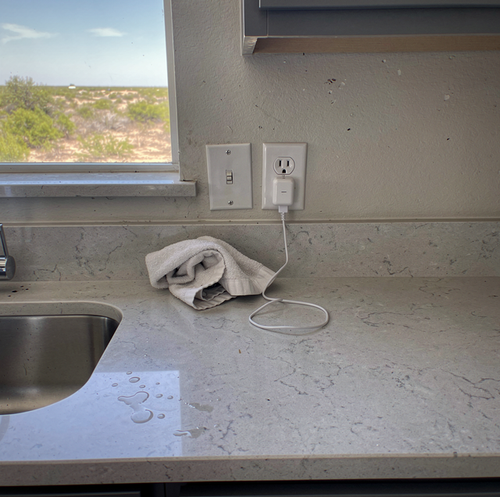
Quick Answer: Partial power loss with no tripped main almost always traces to one of a few things: a tripped GFCI in another room that feeds the dead outlets, a wall switch that controls half the receptacle by design, a breaker that only looks reset, or a loose connection at one outlet that broke the chain to everything downstream. Reset every GFCI and fully cycle the breaker first; the wiring-level faults are the electrician's to find.
You reach to charge your phone and the outlet is dead. So is the lamp on the other wall. But the ceiling light works, the TV across the room is fine, and when you walk to the panel, every breaker looks perfectly normal, nothing flipped, nothing in the middle. Half the room has power and half doesn't, and nothing in the house is telling you why. This is one of the most common calls an electrician gets, and the frustrating part is exactly what makes it solvable: house wiring runs in chains, so when power stops partway down a chain, the break is almost always at one findable point. Here is how to read what died, what still works, and what that pattern is trying to tell you.
Your Outlets Are Wired in a Chain, Not a Grid
The reason half a room can go dark while the other half stays lit comes down to how the wiring is run. Outlets on a circuit are usually connected one to the next in a daisy-chain: power arrives at the first box, and a pair of wires carries it on to the second, then the third, and so on down the line. Picture a string of holiday lights where each bulb passes current to the next. Break the string at any point, and everything past that point goes dark, while everything before it stays lit. That is why a single loose wire or one tripped device can kill a run of outlets that seem unrelated, and why the dead ones are so often clustered together or trailing off in one direction. The location of the break, not a whole-circuit failure, is what you are actually hunting for.
Start Here: The Resets You Can Do Safely
Before anything else, work through the things a homeowner can reset without opening a single box. These fix a large share of partial-power calls on their own.
Fully cycle the breaker- A breaker that trips doesn't always snap all the way to OFF. It can land in a middle, half-tripped position that looks close enough to on that you'd never notice. From that spot, pushing it toward ON does nothing because it was never fully off. Find the breaker for that area, push it firmly all the way to OFF until it clicks, then back to ON. That full-on, then off is the only way to reset it, and a half-reset breaker constantly fools people.
Reset every GFCI in the house, not just the room- This is the surprise that catches almost everyone. A GFCI (the outlet with the little RESET and TEST buttons, common in bathrooms, kitchens, garages, laundry rooms, and exterior walls) can protect not only itself but a string of ordinary outlets wired downstream of it. So a GFCI that tripped in the garage or a back bathroom can quietly kill outlets in a bedroom, a living room, or on the patio, with no clue at the panel. Walk the whole house. Press RESET on every GFCI you can find, including the ones outdoors and in the garage, even if they look fine. One firm press that stays in and doesn't pop back out is what you want.
Check whether a wall switch controls the outlet- Many rooms, especially living rooms and bedrooms with no ceiling fixture, have a "switched" outlet, a receptacle where a wall switch turns the power on and off so you can control a lamp from the door. Flip every switch in the room, one at a time, and watch the dead outlet. If it comes alive with a switch, it was never broken; it is working exactly as wired.
Note the exact pattern- Is it a whole run of outlets that died together, or just part of one? Is it the top half of a single outlet while the bottom half still works? That detail points straight at the cause, as the next sections explain.
The "Half-Hot" Outlet: Dead by Design
Here is a case that isn't a fault at all. Some receptacles are wired as "half-hot" or "switched-split": the top half of the outlet is controlled by a wall switch while the bottom half stays live all the time, or the reverse. It is done on purpose so a lamp plugged into the switched half can be turned off at the door, while a clock or charger in the always-on half keeps running.
If exactly half of one duplex outlet is dead and the other half works, and a nearby wall switch changes which half is live, you are looking at a half-hot outlet doing its job. Try the switch. If the dead half wakes up, nothing needs fixing. If the switch does nothing and half the outlet stays dead no matter what, that is a different story, covered next.
When Half a Single Outlet Dies for Real
A standard duplex receptacle is really two outlets sharing one body, joined by a small metal tab between the terminals that passes power from the top half to the bottom. If that internal tab breaks or the receptacle itself fails on one side, you can lose half the outlet while the other half keeps working, and no switch will bring it back. This is a receptacle failure, not a wiring-chain problem, and it means the device is worn out or damaged inside. The outlet needs to be replaced, which is connection-level work for an electrician.
The Loose Connection That Kills Everything Downstream
When resets don't solve it, and a whole run of outlets is dead past a certain point, the most common real cause is a single failed connection at one box, breaking the chain for everything after it.
Two versions show up again and again. The first is a "back-stab" connection: instead of clamping the wire under a screw, someone pushed the stripped wire into a spring-loaded hole in the back of the receptacle. Those spring tabs have a weaker grip than a tightened screw, and over the years, as the wire warms and cools with current flowing, the tab relaxes, the contact goes intermittent, then open. The moment that connection lets go, every outlet fed through that box loses power, even though the failed outlet might still work on its own path. The second is a burned or loosened wire nut inside a box, where the twisted splice that carries power onward has worked loose or overheated and separated.
Either way, the outlets and the breaker look fine because the breaker is a quiet open circuit at one hidden point. Finding it means opening boxes and testing connections with the power off, which is the electrician's job, not a homeowner's. A loose connection like this can also arc and heat, so it is worth taking seriously rather than living with.
The Open Neutral: Weird Power That Means Call Now
There is one pattern that deserves more urgency than the rest. Every circuit needs both a live wire and a neutral to return the current. If the neutral connection comes loose or breaks somewhere in the chain, an "open neutral," the results get strange rather than simply dead. You might see outlets that work weakly, lights that flicker or glow oddly, bulbs that brighten in one room when you switch something on in another, or power that comes and goes. On multi-wire circuits, an open neutral can also push voltage where it shouldn't be, which can damage plugged-in electronics.
Flickering or fluctuating power combined with half-dead outlets is not a wait-and-see situation. Stop using the affected outlets and have it checked promptly, because an open neutral is both a source of equipment damage and a genuine safety concern. This is the one on the list where the right move is to call rather than keep testing.
Why the Coast Makes This More Common
Living in a humid, salt-air environment adds a steady, year-round push toward exactly these failures. Salt-laden, humid air works its way into outlet boxes, panel connections, and especially outdoor GFCIs and receptacles, corroding the copper contacts and screw terminals inside. Corrosion is just added resistance at a connection, and a corroded joint carries current less reliably, runs warmer, and is quicker to go intermittent or open than a clean, tight one. Outdoor GFCIs take the worst of it, since they face the salt air directly, and a corroded outdoor GFCI that trips or fails can take a string of interior outlets down with it. The moisture and salt never let up with the seasons; they work on the metal all year, which is why homes in salt-air environments see loose-connection and dead-outlet calls a bit more often than the exposure alone would suggest.
Putting the Pattern Together
Partial power loss is a puzzle you solve by reading what died against what still works. Do the safe resets first: fully cycle the breaker off and on, walk the whole house and reset every GFCI, including the outdoor and garage ones, and flip the wall switches to rule out a switched outlet. If half a single outlet is dead, look for a half-hot design or a failed receptacle. If a whole run died past one point and resets didn't fix it, the break is a loose or burned connection at one box, which is the electrician's to find. And if the power is flickering or acting strange rather than just gone, treat that as an open neutral and call without delay.
Frequently Asked Questions
A GFCI has two sets of terminals, "line" and "load." The line side receives incoming power; the load side sends protected power onward to other outlets wired downstream. An electrician can chain several ordinary receptacles, sometimes in entirely different rooms, off one GFCI's load side, so that a single device protects the whole group. When it trips, everything on its load side goes dead at once. That is why a tripped garage or bathroom GFCI can darken a bedroom outlet, and why walking the house to reset every one of them is the fastest first move.
Watch the outlet while you flip nearby wall switches one at a time. If the dead half or the dead outlet comes to life with a switch, it is a switched outlet working as designed, most often set up for a lamp near a doorway. If no switch has any effect and the same half stays dead no matter what you do, it is a fault, either a failed receptacle or a broken connection, rather than a switch. The tell is simple: intentional switching responds to a switch, a fault does not.
A GFCI that clicks but pops right back out, or won't stay in at all, is usually telling you one of three things: there is a real ground fault on the circuit it protects, the GFCI itself has failed (common on older or weather-exposed outdoor units), or it has lost incoming power because something upstream, like a tripped breaker or another GFCI, is out. Try cycling the breaker first. If it still won't hold, don't force it repeatedly; a GFCI that refuses to reset is doing its job by refusing, and the circuit needs to be tested.
It can be, which is why it is worth fixing rather than ignoring. A loose connection doesn't just stop passing power; before it fully opens, it makes a poor, high-resistance contact where current has to jump a tiny gap. That produces heat and can arc, and heat plus arcing inside a wall box is how a bad connection scorches the receptacle, chars the wire insulation, and in the worst case, starts a fire. A run of outlets that goes dead from a loose backstab is the mild version of that same fault; the connection should be corrected properly, not left to keep heating.
You can't change the air, but you can change what it attacks. Outdoors, the fixes are weather-resistant (WR) receptacles paired with an in-use bubble cover that stays closed over a plugged-in cord, plus sealing the wall penetrations and box edges so damp salt air isn't drawn inside. On the connections themselves, screw-terminal or clamp connections hold up far better than push-in backstabs in a corrosive setting, and an electrician can use proper terminations and periodically re-check and tighten them. None of it stops corrosion entirely this close to the water, but it slows it enough that outlets last years longer than neglected ones do.
Sometimes, and it helps to know the difference. If lights across the whole house dim when a big appliance starts, if the flicker hits at the same moment as your neighbors', or if it began right after a storm, the fault can be on the utility side: a loose service neutral out at the weatherhead or the utility connection behaves a lot like an open neutral inside your panel, and it is just as capable of damaging electronics. The tell is scope. A problem confined to one circuit or room is almost always inside your home, while a whole-house or block-wide symptom points outdoors. When it looks utility-side, report it to the power company; when it's isolated to your panel or a single room, that's the electrician's call.
If half a room or an outlet has gone dead and resets didn't bring it back, let a licensed electrician trace the break and make it safe. The Plug Electrical Services serves Corpus Christi, Odem, and Portland. Call (361) 282-3058.
