
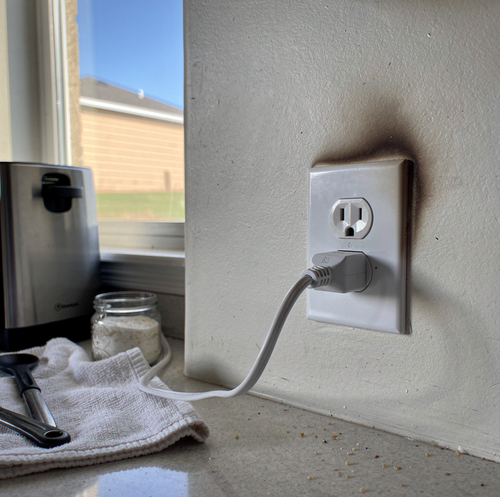
Quick Answer: A burning or fishy smell at an outlet means a component is overheating, usually a loose or arcing connection, an overloaded circuit, a worn receptacle, or a failing cord or plug. Treat it as a fire hazard first: stop using the outlet, unplug what you safely can, switch off that circuit at the breaker, and call a licensed electrician. If you see smoke, sparks, or active heat, call 911.
A burning smell coming from an outlet is never background noise. Something behind that faceplate is hot enough to cook plastic, and the odor is the first and often only warning you get before the situation turns into scorching, sparking, or fire. Sound and heat inside a wall stay hidden until they do not, so the smell is doing you a favor by arriving early.
Treat It As A Fire Hazard Before Anything Else
Diagnosis comes second. The first job is to make the outlet safe, because a component that is already hot enough to smell can reach ignition temperature in minutes, not hours.
A burning smell at an outlet is a fire hazard. Stop using the outlet, unplug what you can remove safely, and switch off that circuit at the breaker. If you see smoke, sparks, active heat you can feel through the wall, or any flame, get people out and call 911.
Stop using the outlet immediately: Do not plug anything else in, and do not keep running whatever is already connected. Every additional minute of current is more heat into a spot that is already failing.
Unplug what you can reach safely: If a cord slides out with light, dry-handed effort and the plug itself is cool, remove it. If the plug or the receptacle is hot to the touch, if you see melting, or if pulling requires force, leave it and go straight to the breaker instead. Do not yank a hot or fused plug.
Kill power to that circuit at the breaker: Go to the panel and switch off the breaker feeding that outlet. This is the one repair-side action a homeowner should take, and it is the action that actually removes the danger, because it stops current to the overheating point. If you are not sure which breaker it is, and the smell is faint and fading with nothing plugged in, you can shut the main off until an electrician identifies the circuit.
Do not keep using it, and do not open it: A dead-feeling outlet that smelled of burning is not "probably fine now." The damage inside does not reverse. Leave the faceplate on. Removing the cover or poking at the wiring exposes you to shock and to live parts you cannot safely evaluate.
If there is smoke, visible sparks, active heat you can feel through the wall, or any flame, call 911: Get people out first, then call. A fire inside a wall cavity spreads through framing and insulation faster than most people expect, and it is often well established before it becomes visible.
Once power is off and nothing is smoking, the outlet is stable enough to wait for a licensed electrician. The remaining sections explain what was probably happening behind the plate, so the diagnosis makes sense to you, not so you can chase it yourself.
What Is Actually Burning
The smell is a symptom of heat, and heat inside an electrical connection almost always traces back to resistance where current is supposed to flow freely. A good connection carries current with almost no heat. A bad one turns some of that electricity into warmth right at the fault, the same way a dimming bulb warms its own base. Enough resistance in a small enough spot, and plastic starts to break down.
Loose or backstabbed connections arcing: The most common cause is a loose wire connection inside the receptacle. Where a wire meets a terminal, any looseness forces the current to jump a tiny gap. That is arcing, and an arc runs far hotter than the wire around it. Many older or builder-grade outlets use "backstab" holes on the rear, where the wire is pushed into a spring clip instead of clamped under a screw. Those clips loosen over years of thermal expansion and vibration, which is why a backstabbed outlet is a frequent source of that hot-plastic smell. An electrician will typically move those wires to the side screw terminals or replace the device outright.
An overloaded circuit: Plug too much load onto one circuit and the wiring runs warmer than it was sized for. Space heaters are the classic offender, because a single heater can pull close to the full rating of a common household circuit by itself. Add a second high-draw appliance on the same run, and the weakest point, often a worn receptacle or a marginal splice, heats up first and starts to smell. Power strips and daisy-chained extension cords make this worse by concentrating several loads onto one wall outlet.
An aging or damaged receptacle: Receptacles wear out. The internal metal contacts that grip a plug's prongs lose their spring tension after years of insertions, and loose contacts mean higher resistance and more heat. A receptacle that no longer holds a plug snugly, that feels loose when you plug in, or that has visible scorch marks is at the end of its service life. Heat and ordinary aging both degrade the plastic and the contacts, so this is not limited to any one time of year.
Aluminum wiring terminations: Homes wired with aluminum branch circuits during a stretch of the 1960s and 1970s have a known failure point at the connections. Aluminum expands, contracts, and oxidizes differently than copper, so terminations that were tight on day one can loosen and overheat decades later. If a home has aluminum wiring, an overheating outlet is a signal to have every device evaluated and corrected with connectors and methods rated for aluminum, not just the one that smelled.
A bad plug or cord: Sometimes the wall is fine, and the fault is in what you plugged in. A cracked plug, a frayed cord, a bent prong, or a cheap adapter can develop its own high-resistance hot spot. That is why unplugging suspect devices is part of the first response. If the smell and the heat leave with the device, the appliance cord is the suspect, and that item should stay unplugged until it is repaired or replaced.
Why The "Fishy" Smell Means Burning Plastic
People describe the odor differently, and the words are a useful clue. A sharp, acrid, electrical smell tends to mean components are getting hot fast. A faintly sweet or fishy smell is the giveaway that plastic is being cooked slowly. The housings, wire insulation, and outlet bodies are made from plastics and flame-retardant compounds, and as they overheat, they release chemicals with an odor many people read as "fishy" or "like dead fish."
That distinction matters for one reason: the fishy smell often shows up before you see any scorching at all. It means the breakdown is underway inside the wall where you cannot see it. So a fishy or fishlike smell with no visible mark is not milder than a scorch; it is an earlier stage of the same failure, and it deserves the same shut-off-and-call response.
Why This Is Licensed-Electrician Work
An overheating outlet is a fire and shock hazard, and the actual fix lives inside the wall where the hazard is. A licensed electrician can safely de-energize and verify the circuit, open the box, and read what a homeowner cannot: whether the terminals were backstabbed, whether a splice in the box is failing, whether the branch is aluminum, whether the receptacle is simply worn, or whether the circuit is carrying more than it should. The correct repair depends on which of those it is, and guessing wrong leaves a fire risk buried in the wall.
Killing the breaker is where a homeowner's role ends, and a professional's begins. Everything past the faceplate involves live conductors, connection methods that have to be right the first time, and judgment about the whole circuit rather than the single outlet you noticed. The smell told you something is wrong. A licensed electrician tells you exactly what it is and makes it safe.
Frequently Asked Questions
There is no safe waiting window to quote, because the interval between a faint smell and open flame can be minutes if the fault is an active arc. A useful field rule: if any warmth accompanies the smell you can feel on the faceplate, treat it as immediate and get the breaker off within minutes. A one-time whiff that never returns after you unplug a device is lower urgency, but it still warrants an inspection, not a shrug.
No. Cutting the breaker removes the danger by stopping current, but it does not repair the loose terminal, worn contact, or damaged wire that caused the heat. The moment power returns, the same fault resumes and often accelerates, because arcing damage pits and corrodes the metal a little more each cycle. The breaker buys safe time to wait for a repair, nothing more.
An AFCI (arc-fault) breaker or receptacle is specifically designed to detect the erratic arcing signature of a loose connection and trip before it starts a fire, which is why modern circuits in living areas use them. A GFCI protects against shock by catching current leaking to ground, a different job. Neither cancels the need to investigate a burning smell, but an AFCI that keeps tripping is often pointing at exactly the kind of fault that causes one.
Not necessarily. A scorch or a melted face usually means the receptacle itself is destroyed and must be replaced, but the branch wiring behind it may be sound if the fault was contained to the device. The electrician's job is to inspect the conductors and the box for heat damage. Charred insulation, brittle wire, or a burnt splice means the damaged section gets addressed too, while clean copper behind a fried outlet often needs a new device and proper terminations.
Sometimes, and it is worth checking. A single worn receptacle is a local issue. But repeated overheating at several outlets, warm cover plates in more than one spot, or breakers that run hot can point upstream to an overloaded circuit, undersized wiring, or a panel connection issue. An electrician looks at whether the problem is isolated to one device or a pattern across the circuit before calling it solved.
They add electronics and more internal connections to the same box, so a low-quality unit gives heat more places to build. The bigger risk is cumulative load: people treat a USB or smart outlet as an invitation to run more devices from one point, which pushes the circuit toward the overload range. Quality-listed devices from a reputable maker, kept within their rated load, are the safeguard, and any smart or USB outlet that runs warm to the touch should be pulled from service and inspected.
Smelling something burning at an outlet? Do not wait it out — get it diagnosed and made safe by a licensed pro. The Plug Electrical Services serves Corpus Christi, Odem, and Portland. Call (361) 282-3058.
