
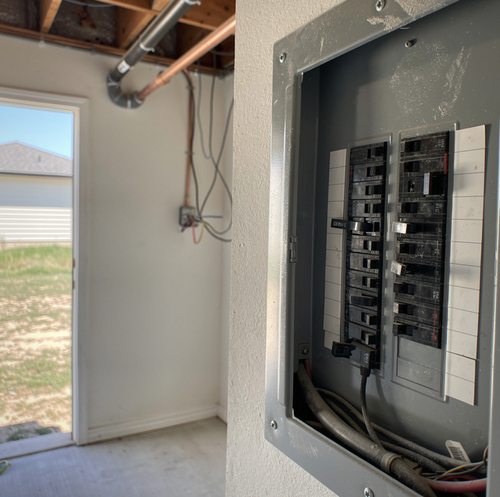
Quick Answer: A dedicated circuit serves one appliance from its own breaker and wire, so a high-draw device (refrigerator, range, dryer, HVAC, EV charger, and similar) never shares power with anything else. It prevents overloads, tripped breakers, and overheated wiring. Adding one means running new wire from the panel, which is licensed-electrician work.
A dedicated circuit is a single circuit that runs from one breaker in your electrical panel, through its own wire, to one appliance or one outlet, and nothing else. No other lights, outlets, or devices tap into it. That one appliance gets the full capacity of the circuit, so it never competes with a toaster, a phone charger, or the living-room lamps for the power it needs to run.
Most of the trouble people have with tripping breakers, warm cords, and lights that flicker traces back to the opposite arrangement: a big power-hungry appliance sharing a circuit with several other things. Understanding what a dedicated circuit is starts with understanding how a normal shared circuit works and where it runs out of room.
How A Circuit Works And Where Sharing Goes Wrong
A circuit is a loop of wire that leaves the panel on a breaker, travels to a set of outlets and fixtures, and returns. The breaker is the safety limit. A common household branch circuit is protected at 15 or 20 amps, and that number is a ceiling on how much current everything on that loop can pull at the same time before the breaker shuts it off.
Most rooms are wired so several outlets and lights share one circuit. That works fine for low-draw items. A lamp, a laptop charger, and a television together pull only a fraction of what the circuit allows. The problem shows up when a heavy appliance joins that same loop.
Think of the circuit as a single-lane driveway. A few compact cars share it without trouble. Park a delivery truck across it and nothing else fits. A large appliance is that truck. It pulls so much current on its own that it leaves almost no room for anything else on the line.
When demand climbs past the breaker's rating, one of two things happens. The breaker trips and cuts power, which is the outcome you want because it is doing its job. Or, if a circuit is loaded near its limit for long stretches, the wiring itself runs warm because it is carrying more current than it comfortably should. Persistent heat in wiring insulation is how electrical fires start, which is why a repeatedly overloaded circuit is a real hazard and not just an annoyance.
Why Dedicated Circuits Exist
Large appliances draw a lot of current, and many draw the most at the moment they switch on. A motor-driven appliance like a refrigerator compressor, an air conditioner, or a garbage disposal pulls a brief surge as it starts, well above what it uses while running. Heating appliances like ranges, dryers, and water heaters pull heavily the entire time they are on because turning electricity into heat takes serious power.
Put one of those on a shared circuit and the results are predictable. The breaker trips when a second device runs at the same time. Lights on the same circuit dim or flicker the instant the appliance kicks on, because the surge briefly pulls voltage down for everything else on the loop. Cords and outlets feeding the appliance run warm. Give that appliance its own dedicated circuit and every one of these problems goes away, because the appliance has the whole circuit and the breaker is sized to match exactly what it needs.
Which Appliances Typically Need One
As a rule, anything that draws heavily, runs long, or has a motor that surges on startup belongs on its own circuit. Common examples include:
- Refrigerator and separate freezer
- Electric range, oven, and cooktop
- Built-in microwave
- Dishwasher
- Garbage disposal
- Clothes washer
- Electric clothes dryer
- Central HVAC, air handlers, and window or through-wall air conditioners
- Electric water heater
- EV charger
- Fixed or high-wattage space heaters
- Sump pump
- Large workshop tools such as a table saw, air compressor, or welder
Smaller plug-in items usually do not need their own circuit, but two habits cause overloads worth flagging. Running a portable space heater on the same circuit as other electronics is a frequent winter trip, and the same heater loads the circuit just as hard whenever it runs. And feeding any large appliance through an extension cord or a power strip is unsafe in every season, because those are built for light loads and can overheat under an appliance's draw. High-draw appliances belong on a permanent outlet on a dedicated circuit, never on a cord run across the floor.
The Signs You Need One
You rarely have to guess. The wiring tells you:
A breaker that trips when two things run together: If the kitchen breaker drops every time the microwave and the toaster overlap, the circuit is carrying more than it can handle. Resetting it again and again, or swapping in a larger breaker to stop the nuisance, is the wrong fix and a dangerous one.
Never fit a larger breaker just to stop a circuit tripping. A bigger breaker on the same wire lets the wire overheat inside the wall before the breaker ever trips, which removes the protection and is how electrical fires start. The tripping is the warning, and the fix is a correctly sized circuit.
Lights that dim when an appliance starts: A brief dip when the AC or the disposal kicks on means that startup surge is pulling the whole circuit down. It confirms the appliance is sharing a line it should have to itself.
Warm outlets, warm cords, or a faint burning smell: Heat at an outlet or plug means current beyond what that point is rated to carry. This is a stop-now sign. Cut power to that circuit at the panel and call an electrician. Scorch marks or a burning smell mean the same thing, more urgently.
Extension cords or power strips feeding big appliances: If a refrigerator, a heater, or a shop tool is plugged into anything other than a wall outlet on its own circuit, treat that as a temporary setup that needs a permanent one.
How A Dedicated Circuit Is Sized To The Appliance
A dedicated circuit is not one-size-fits-all. The breaker and the wire gauge are both matched to the appliance's load, and the two have to agree. Wire is rated to carry a certain current safely, and the breaker has to trip before the wire is pushed past that rating. A heavier appliance needs a thicker wire and a larger breaker; a lighter one needs less. Getting this pairing right is the core of the work, and getting it wrong is how wiring overheats.
Voltage is part of the sizing too. Everyday outlets in a home run at 120 volts, which suits most appliances. The largest ones- an electric range, an electric dryer, central air conditioning, a water heater, and most EV chargers- run on 240 volts, which lets them do heavy heating or motor work more efficiently. A 240-volt circuit uses a different breaker and a different outlet shape, so the appliance and the circuit have to be built for the same voltage from the start.
Because every appliance has its own current and voltage requirement, a dedicated circuit is designed around the specific unit it will feed. That is why it is common for a new appliance to arrive with a spec sheet calling for a particular circuit, and why swapping in a bigger appliance sometimes means the old circuit no longer fits.
Why New Installations And Additions Often Require One
When a large appliance is installed or replaced with a more powerful model, a dedicated circuit is frequently part of the job rather than an upgrade. The appliance's own requirements drive it: the unit is built to draw a set amount of current, and it needs a circuit that can deliver that safely without leaning on other outlets. Adding a room, a workshop, or an EV charger usually adds a load the existing panel was never wired to carry on a shared line, so a new dedicated circuit is run for it.
Adding a dedicated circuit means running new wire from the panel to the appliance's location and landing a new breaker in the panel. That is work inside the service panel, where conductors carry lethal voltage even when individual breakers are off. It calls for correctly sizing the breaker and wire to the load, confirming the panel has room and capacity for another circuit, and making every connection sound. This is licensed-electrician territory, both for safety and because new circuits are inspected work. A pro will also confirm your panel can take the added load before adding to it, since a full or undersized panel sometimes has to be addressed first.
Frequently Asked Questions
No, and it is one of the more dangerous shortcuts in a home. A breaker is sized to protect the wire behind it, not the appliance. If a 15-amp circuit uses 14-gauge wire, putting a 20-amp breaker on it lets the wire carry current it was never rated for, and the wire can overheat inside the wall before the breaker ever trips. The tripping is the warning; the fix is a correctly sized circuit, not a higher number on the breaker.
They solve different problems. A dedicated circuit is about capacity, giving one appliance a line to itself so it does not overload a shared circuit. A GFCI (ground-fault) device cuts power fast if current leaks to ground, which protects against shock in wet areas like kitchens, baths, and outdoors. An AFCI (arc-fault) device trips when it senses the erratic sparking of a damaged wire or loose connection. An appliance can need all three: its own circuit for capacity, plus ground-fault or arc-fault protection depending on where it is.
The clearest check is at the panel. Turn off one breaker and see what loses power. If only that single appliance or outlet goes dead and nothing else in the house does, it is on a dedicated circuit. If lights or other outlets die along with it, they share the line. A 240-volt outlet with a larger, differently shaped face (like a dryer or range receptacle) is almost always dedicated by design.
No. A dedicated circuit does not change how much energy an appliance uses; the appliance draws the same current whether it is alone on a circuit or sharing one. What changes is safety and reliability. The appliance gets steady, uninterrupted power, and the wiring is never pushed past its limit. Your energy use is set by the appliance itself, not by how the circuit is arranged.
Because both are cycling appliances, and the trip happens when their peaks line up. A refrigerator compressor kicks on and off through the day, and a microwave only draws its full load while running. Most of the time, only one is pulling hard, so the shared circuit copes. When the fridge compressor surges on at the same moment the microwave is heating, their combined draw briefly tops the breaker's rating, and it trips. Intermittent trips like these are a classic sign each appliance needs its own circuit.
Sometimes, but it is rarely as simple as relabeling it. Making an outlet dedicated means it can no longer share its wire with anything else, so an electrician often has to run a new home run of wire from the panel to that location and add a breaker, rather than reuse the existing shared wiring. Whether it is practical depends on the route to the panel, whether the panel has an open slot, and whether the panel has spare capacity. An electrician can tell you quickly which of those apply.
Book a load assessment before your next big appliance install — get the right dedicated circuit sized and installed safely. The Plug Electrical serves Corpus Christi, Portland, and Robstown. Call (361) 282-3058.
