
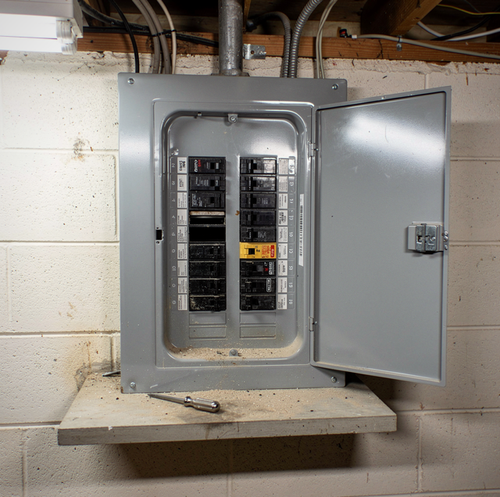
Quick Answer: An AFCI breaker detects the low-level electrical arcing that a standard breaker ignores and cuts the circuit before that arcing can ignite the surrounding wood, insulation, or dust. A standard breaker only trips on overloads and short circuits. Arcing produces neither at first, so the AFCI fills the gap between "everything is fine" and "a fire has started."
An AFCI breaker, short for arc-fault circuit interrupter, watches for a specific kind of electrical trouble that a standard breaker was never built to catch: arcing. A regular breaker only reacts to two things: a circuit drawing more current than it should (an overload) or a hot wire touching a neutral or ground and dumping a huge surge (a short). Plenty of dangerous faults slip right past both of those tests, and the most dangerous of all is the arc.
What an Electrical Arc Actually Is
An arc is electricity jumping across a small gap instead of flowing cleanly through metal. When two conductors that should touch firmly come slightly apart, or when a wire is damaged so current has to leap across a break, the electricity crosses the air in a tiny, sputtering spark that repeats hundreds of times a second.
That spark is hot. An arc can reach temperatures far above what it takes to ignite wood framing, paper-backed insulation, dust, or the plastic sheathing on the wire itself. What makes arcing so dangerous is that the current stays low. A cleanly arcing connection might draw the same modest amperage as a working lamp, so a standard breaker sees nothing wrong and never trips, even while a hot spot smolders inside a wall for hours or weeks.
There are two broad flavors. A series arc happens along a single conductor that has partly broken, so current arcs across the gap in the same wire, common at a loose screw terminal or a cracked cord. A parallel arc happens between two different conductors, hot to neutral or hot to ground, where insulation has failed. An AFCI is designed to recognize the erratic electrical signature both types produce and distinguish it from the normal switching sparks of everyday appliances.
Why a Normal Breaker Misses It
A standard breaker is essentially a current gate. It asks one question: is more current flowing than this wire can safely carry? If a hair dryer and a space heater overload a circuit, the breaker trips. If a nail pierces a cable and slams hot straight into ground, the surge trips it almost instantly.
Arcing sits in the blind spot between those two conditions. The current through an arcing connection is often perfectly normal in size; it just is not flowing smoothly. The waveform stutters and chops in a way a simple current gate cannot read. An AFCI adds a small electronics package that analyzes the shape of the current many times per second, looking for the chaotic, high-frequency pattern that signals arcing rather than a clean load.
AFCI Versus GFCI, and the Combo Device
These two protective devices get confused constantly because both replace an ordinary breaker or outlet, but they guard against different dangers.
An AFCI protects against fire: It watches for arcing that could ignite building materials, and it cares about the quality of the current flow.
A GFCI protects against shock: A ground-fault circuit interrupter measures whether the current leaving on the hot wire returns exactly on the neutral. If even a small amount is leaking elsewhere, through a person, through water, through a fault to ground, it trips in a fraction of a second to prevent electrocution. That is why GFCIs guard kitchens, bathrooms, garages, and outdoor receptacles where water and hands meet electricity.
They answer different questions, so one is not a substitute for the other. Because both protections are often wanted on the same circuit, manufacturers make a dual-function AFCI/GFCI breaker or receptacle that does both jobs in one device. If your panel or outlet is labeled dual-function, it is watching for arcing fire risk and shock-causing leakage at the same time.
What Actually Causes Arcing
Arcing almost always traces back to a physical flaw in the wiring or a cord, and the usual suspects are ordinary wear and small mistakes rather than anything exotic:
- Loose terminal screws at outlets, switches, or the breaker itself, where a connection that vibrated or was never fully tightened lets current arc across the gap.
- Damaged or pinched cable, such as a wire crushed by a staple driven too tight or squeezed under a heavy piece of furniture against a baseboard.
- A nail or screw driven through a hidden wire during hanging shelves, art, or trim, nicking the conductor without fully severing it.
- Cracked or brittle insulation on older wiring or on cords that have been flexed, heated, or gnawed by pests until the copper is exposed.
- Worn appliance and extension cords, especially at the plug end and where the cord bends over a table edge or gets run under a rug.
- Corroded or overheated connections that have degraded slowly, leaving a high-resistance spot that begins to spark.
Because these faults hide inside walls, behind furniture, and inside appliance cords, most are invisible until something starts to smell or scorch. That is the gap an AFCI is meant to close.
Where AFCI Protection Is Expected
Modern residential wiring rules have steadily widened where arc-fault protection belongs. It started in bedrooms, on the logic that people sleep there and a smoldering fault is deadliest when nobody is awake to notice. Over successive updates, the expectation spread to most living areas, so a current-standard home commonly carries AFCI protection on circuits feeding bedrooms, living rooms, family rooms, hallways, closets, and similar general-use spaces.
Requirements vary by where you live, by when the home was wired, and by which edition of the local rules was in force at the time, so the only reliable way to know what your specific panel needs is to have a licensed electrician verify it against the code your jurisdiction currently enforces. An older home wired before these rules existed is generally not forced to retrofit, but adding AFCI protection during a remodel or panel upgrade is a meaningful safety improvement either way.
Why AFCIs Sometimes Nuisance Trip
An AFCI is reading a fast, subtle electrical signature, and a few normal situations can produce a pattern close enough to arcing that the breaker trips defensively even though nothing is actually dangerous. This is what electricians call a nuisance trip.
The common triggers are shared neutrals, where two circuits were wired to return on one neutral conductor and the AFCI cannot cleanly separate the two current flows, and certain motors and electronics whose switching noise mimics an arc, older vacuum motors, some treadmills, a few dimmers, and cheap power supplies among them.
A nuisance trip is a wiring or compatibility issue to diagnose, not a defect to ignore. The reasoning cuts both ways: a breaker that trips because of a shared neutral is telling you about a real wiring condition worth correcting, while a breaker that keeps tripping on a truly arcing cord is doing exactly its job. Sorting which is which is the electrician's task, because the wrong assumption in either direction leaves either a fire risk in place or a repeatedly dead circuit. The move that is never acceptable is swapping the AFCI for a standard breaker to make the tripping stop, because that quietly removes the fire protection the circuit was required to have.
How to Reset and Test One
Resetting an AFCI works like any breaker. When one trips, its handle usually rests in a middle position rather than fully off. To restore power, push the handle firmly all the way to OFF first, then back to ON. If it holds, the trip may have been a one-time event. If it snaps off again immediately or within minutes, stop resetting it and treat that as a real fault report.
Testing confirms the protection still functions. Manufacturers commonly suggest testing every AFCI on a regular schedule, a good habit to pair with the same day you test smoke alarms. A breaker that will not trip when you press its test button has failed and needs replacement by a qualified electrician.
Test each AFCI on a regular schedule by pressing its TEST button with the breaker on; it should trip and prove the sensing electronics still work. Pair it with the day you test your smoke alarms, and reset the breaker afterward to restore power.
When to Stop and Call a Professional
An AFCI that trips over and over is not misbehaving; it is warning you. Repeated tripping means the breaker is sensing something it reads as arcing, and the safe response is to have the circuit diagnosed, not to keep resetting it and not to replace it with a standard breaker that would silence the warning by removing the protection.
Anything involving the panel itself is licensed-electrician work. The bus bars inside a service panel carry lethal voltage even when individual breakers are off, and diagnosing an arc fault often means opening junctions and tracing wiring that a homeowner is not equipped to handle safely.
A burning or acrid smell, a warm or discolored outlet or switch plate, a scorch mark, or a buzzing or sizzling sound from a receptacle all point to active arcing or overheating. Cut power to that circuit at the panel if you can do so safely and call a licensed electrician rather than continuing to use it.
Frequently Asked Questions
Swapping a breaker means working inside an energized service panel, where the main lugs and bus bars stay live even with the main breaker off unless the utility disconnects power. That is licensed-electrician work in nearly every jurisdiction, and AFCIs add a wrinkle: they require the circuit's neutral to land on the breaker's own neutral terminal rather than the panel neutral bar, a wiring detail that trips up do-it-yourself swaps and can cause immediate nuisance tripping if done wrong.
Both exist. Alongside AFCI breakers, there are AFCI receptacles that install at the first outlet on a circuit and protect everything downstream of that point. They are useful when a panel is too old to accept modern AFCI breakers or when replacing a whole panel is not practical, though a breaker-based approach protects the full length of the circuit wiring, including the run between the panel and that first outlet.
The electronics inside an AFCI have a finite service life, and most manufacturers treat roughly 30 to 40 years as the outer expectation for a breaker, similar to standard breakers. What matters more in practice is testing: an AFCI can fail silently while still passing normal current, so the monthly test-button check is what actually confirms the sensing circuitry is alive, not the age printed on the label.
No, and treating it as total coverage is a mistake. An AFCI targets arcing faults specifically. It does not stop a fire from a badly overloaded extension cord run under a rug that overheats without arcing, nor from a failed appliance heating element. Working smoke alarms and sensible cord habits remain part of the picture; the AFCI closes one important gap rather than all of them.
Certain devices generate electrical noise that an AFCI can read as arcing, so a new vacuum, treadmill, LED driver, or inexpensive switching power supply can trigger trips that never happened before. This points to a compatibility conflict rather than damaged house wiring, and an electrician can confirm it by testing the circuit with and without that appliance before deciding whether a filter, a different circuit, or a breaker of a different design is the fix.
A dual-function device really does perform both jobs, arc-fault sensing for fire and ground-fault sensing for shock, in a single breaker or receptacle, so in that one unit the two protections coexist. They remain separate functions internally, which is why pressing the test button on a dual-function device checks both mechanisms and why either one tripping tells you something different about the circuit.
Ask a licensed electrician to check your panel's arc-fault protection — a fast inspection that closes a real fire-risk gap. The Plug Electrical Services serves Corpus Christi, Odem, and Portland. Call (361) 282-3058.
